

The Ultimate Guide to Selecting and Planning Commercial Indoor Playground Equipment
Discover expert insights with Far Kids Island’s Guide to Selecting and Planning Commercial Indoor Playground Equipment. As a leading Commercial Indoor Playground Equipment manufacturer, we help you create safe, engaging play spaces that boost fun and business success.
Social Links
Introduction
Planning a commercial indoor playground looks straightforward on paper. You have a floor plan, a budget, and a vision. Then reality arrives: the venue has load-bearing columns running through the center of your prime play zone, the ceiling drops to 4.2 meters in exactly the corner where the multi-level structure needs to go, and the fire marshal's requirements for your local jurisdiction don't quite line up with the standard specifications in the manufacturer's catalog.
This is the normal experience of anyone who has actually taken a commercial indoor play project from lease signing to opening day. The gap between "equipment selection" and "a fully operational, code-compliant, profitable play facility" is filled with decisions that most buyers don't know they need to make until they're already standing in an empty warehouse with a construction deadline.
This guide is written from the perspective of the engineering and project delivery side of the industry — the people who deal with these exact problems across dozens of installations every year. We are not going to tell you which colors children prefer or cite vague statistics about the "growing indoor play market." Instead, we will walk through the five critical problem areas that actually determine whether a commercial indoor playground project succeeds or fails: spatial constraints, age zoning, material quality, safety certification compliance, and the operational questions that experienced buyers ask before they commit.
Solving Spatial Challenges: Site Evaluation and Layout Planning
The floor plan is where most commercial indoor playground projects go wrong — not because of poor design intent, but because site conditions get underestimated at the planning stage. The cost of catching these issues at the design stage is essentially zero; the cost of catching them during installation is significant.
Overcoming Structural Obstacles: Columns, HVAC Ducts, and Low Ceilings
Almost every commercial venue that was not purpose-built for a play facility has structural challenges. When maximizing indoor play space layout, the instinct among first-time operators is to treat columns as dead space and design around them. This is usually the wrong approach.
To properly integrate structural obstacles, consider the following engineering standards:
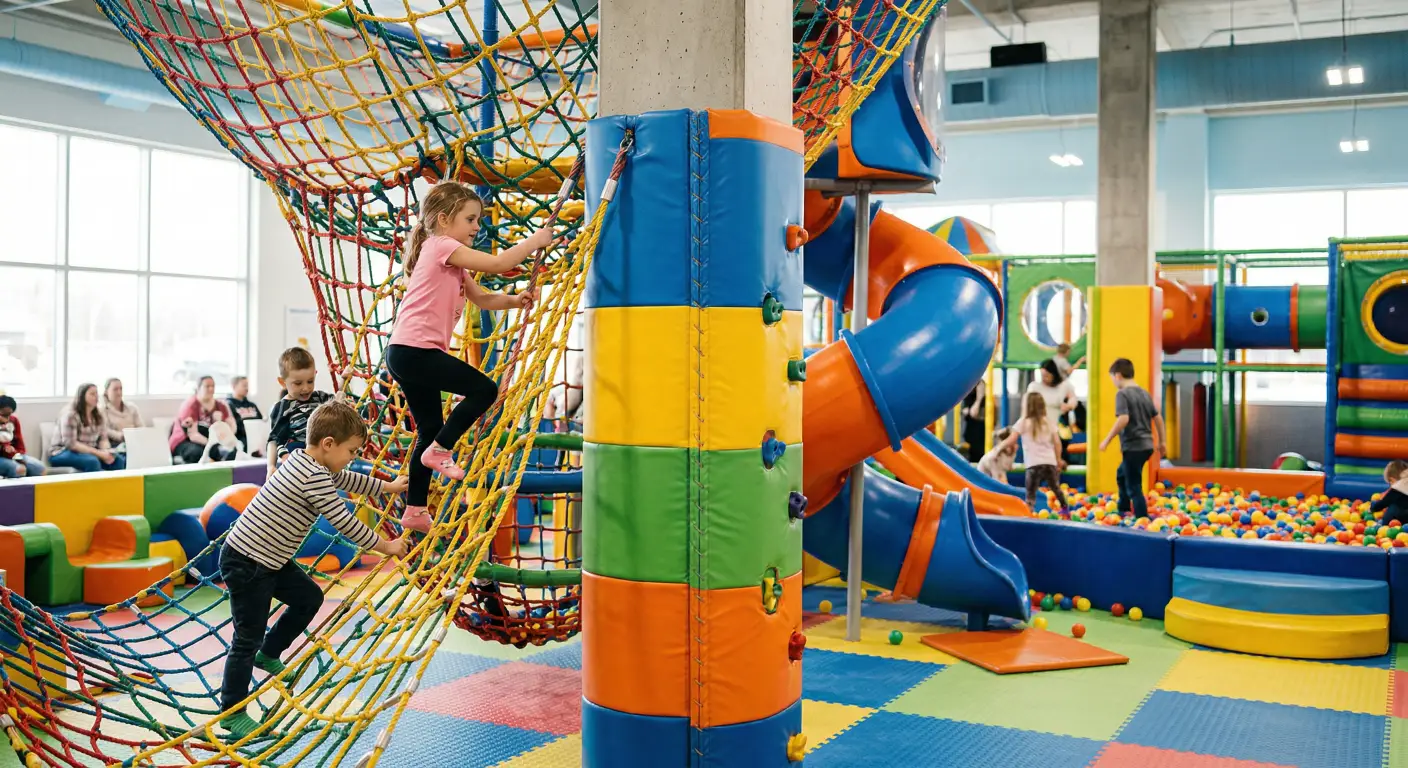
- Column Integration: A column wrapped in 50mm EPE foam and covered in fire-retardant PVC becomes a safe, vertical element that can anchor climbing walls or support netting enclosures.
- Mechanical Securing: The foam wrapping must cover the full height of the column within the reachable play area and must be secured mechanically, not with adhesive alone (which detaches within 6–12 months).
- Ceiling Clearances: The absolute minimum clearance between the highest accessible surface and any overhead obstruction (including sprinkler heads and HVAC vents) is 600mm for occupied static surfaces (platforms, walkways) and 1,500mm for any surface a child is likely to stand upright on.
Designing Clear Sightlines for Parental Supervision
When parents cannot see their children from the seating area, they enter the play structure to search for them, increasing congestion and collision risks. A well-designed commercial indoor playground layout maintains unobstructed sight lines at a seated adult eye level (approx. 1,100–1,200mm from the floor). In practical terms, this means:
- Solid wall panels at the base of the structure should not exceed 800mm in height facing the seating area.
- Above 800mm, mesh netting panels (with openings no larger than 50mm) allow visual access while maintaining containment.
- The primary play entry/exit point should be entirely visible from the main seating area.
- Multi-level structures require open mesh floors on lower platform levels so parents can look upward.
Age-Appropriate Zoning: Preventing Collisions and Enhancing Safety
Age-based zoning is the single most important structural safety decision in commercial indoor playground planning. A single collision injury involving an infant in a non-zoned facility can result in permanent reputational damage.
Creating Strict Boundaries for Toddler Zones (Ages 0–3)
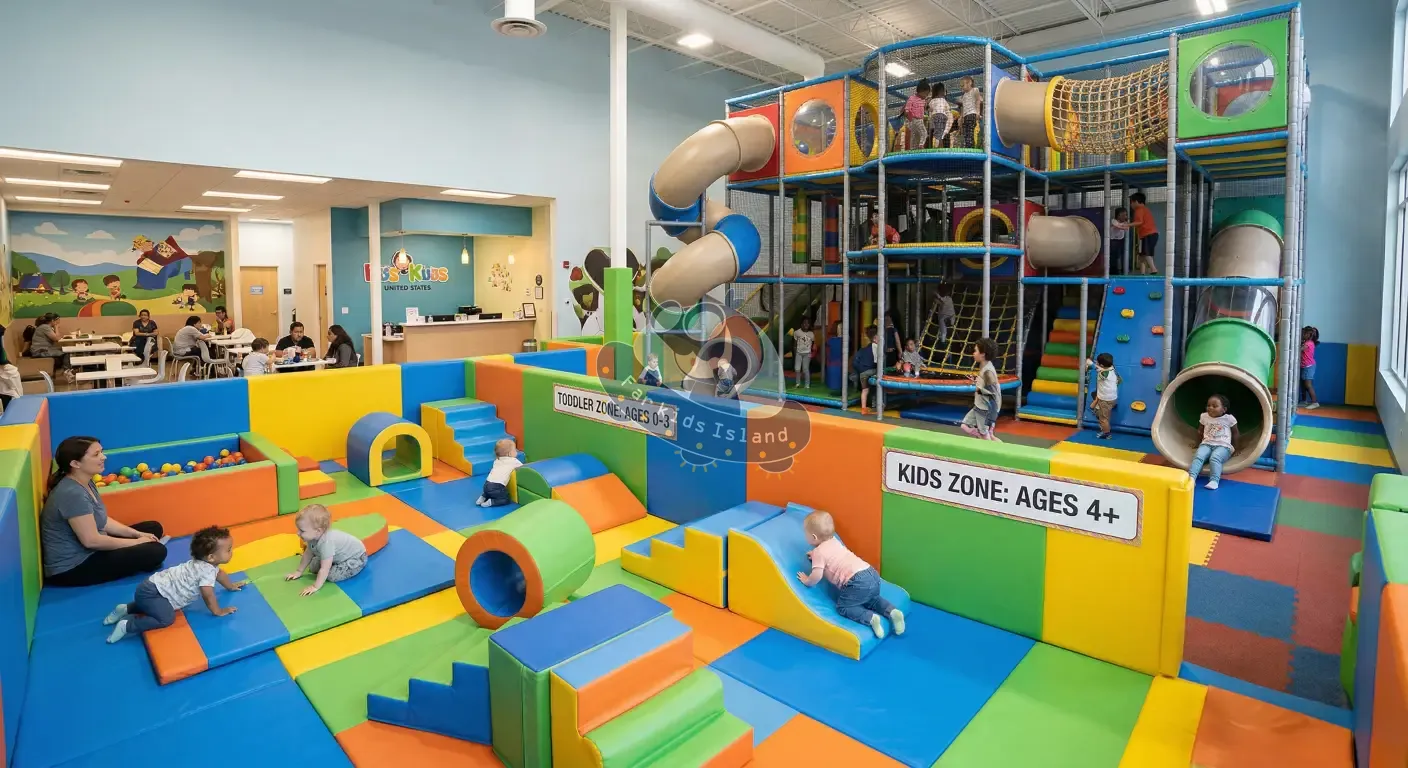
Children under three years old have fundamentally different physical vulnerability profiles. A toddler area physically contiguous with the main play zone — separated only by signage — is not a protected zone. A genuine toddler zone requires:
- Physical Boundary Separation: A continuous barrier (soft-panel walls or mesh enclosures) forming a closed perimeter with a single controlled entry point.
- Height Restrictions: Maximum fall height of 600mm from any accessible surface to the floor level below (aligning with EN 1176 standards).
- Soft Equipment Only: All custom indoor play structures must be entirely soft-bodied (foam blocks, soft-play modules). No rigid climbing frames or hard plastic structural elements at floor level.
Flow Management for High-Activity Zones
When entry and exit flow through the same point in high-activity zones (slides, trampolines), collisions predictably occur. The engineering solution is clearly defined, separate paths:
- Slide Exits: The slide exit at ground level should discharge into a padded landing zone separated from the climbing entry path by at least 1,500mm.
- Trampoline Queues: Entry queuing should be perpendicular to the trampoline surface, ensuring waiting children are out of the active fall zone.
- Anti-Reverse Climbing: Slide tubes must have steep enough angles (minimum 25° gradient) and smooth interior surfaces to discourage children from attempting to climb back up.
Identifying True Commercial-Grade Materials
Commercial indoor playground equipment operates under harsh conditions: 10–14 hours of daily use, high humidity, and extreme mechanical stress. This is where partnering with a true indoor playground manufacturer rather than a middleman proves its critical value.
The Steel Framework: Gauge, Galvanization, and Welding Quality
The structural steel framework is the element that fails most catastrophically if quality is compromised:
- Wall Thickness: Commercial-grade equipment must use galvanized steel tubes with a minimum wall thickness of 2.0mm for main structural members (economy equipment often uses 1.2mm–1.5mm, which fatigues quickly).
- Galvanization: For high-humidity environments, demand Hot-dip galvanization (HDG), which provides a 45–85 micron zinc layer, far superior to standard electrogalvanized coatings.
- Weld Quality: Poor welds cause structural fatigue cracking. Request photos or videos of weld cross-sections from your supplier’s quality control inspections.
Soft Padding and Protective Netting: Density and Durability
When evaluating safe playground materials, visual inspection is not enough. You must verify the technical specifications:
- Foam Density: EPE or XLPE foam must have a density of at least 35 kg/m³. Lower-density foam (20–25 kg/m³) loses its energy-absorption properties within 12–18 months. (Field test: Press firmly into the pad; high-density foam returns to its shape in 2–3 seconds).
- PVC Covering: Outer PVC leather must meet fire retardancy standards (self-extinguishing per BS 5852) and tear resistance minimums (50N/mm per ISO 34-1).
- Netting Strength: UV-stabilized high-strength nylon must have a minimum strand breaking strength of 200N. Installed netting should deflect no more than 50mm under a 100N point load to prevent limbs from slipping through.
Navigating Safety Certifications: Beyond Looking at the Certificate
A certificate on a product page only proves that a specific sample passed a test on a specific date. You must understand what the certifications actually cover for your specific configuration.
Entrapment Hazards and ASTM / EN Standards
Safety standards primarily focus on entrapment — mechanical injury mechanisms where body parts get caught:
- Head Entrapment (Probe Test): Per EN 1176 and ASTM F1487, any opening must either be smaller than 89mm (preventing head entry) or larger than 230mm (allowing complete withdrawal). The 89–230mm range is strictly prohibited.
- Finger and Limb Entrapment: All bolt ends must be recessed or covered with rounded caps. Frame connections must be sealed with fitted end caps requiring tools to remove.
Fall Zones and Impact-Absorbing Flooring: The CFH Calculation
Critical Fall Height (CFH) is the maximum height from which a child could fall from an accessible point to the surface below. The CFH drives the required Head Injury Criterion (HIC) value the flooring must achieve.
Here is the standard flooring requirement based on CFH:
|
Equipment Type |
Typical CFH |
Minimum Flooring Requirement |
|
Toddler soft play (max platform 600mm) |
600mm |
20mm EVA foam tiles (HIC < 1000) |
|
Standard multi-level structure (max height 2.0m) |
2,000mm |
40mm EVA interlocking tiles or rubber mat |
|
High structure (max height 3.0m+) |
3,000mm+ |
50mm+ rubber tiles or engineered rubber pour-in-place |
|
Slide landing zone |
Calculated from slide exit height |
Minimum 50mm impact pad at exit point |
|
Trampoline surround |
Per trampoline frame height |
Trampoline-specific foam padding per ASTM F2970 |
Note: The protected fall zone extends at least 1,800mm horizontally from any point a child could fall (for CFH above 600mm), which heavily impacts your flooring budget.
Frequently Asked Questions for Playground Planners
Q1: How Much Ceiling Clearance Is Required Between the Play Structure and the Ceiling?
- Answer: The engineering minimum is 600mm above seated/crawling surfaces and 1,500mm above standing surfaces. However, you must measure clearance independently from structural ceilings, HVAC ducts, lighting, and fire sprinklers (which strictly dictate unobstructed buffer zones). Always conduct a physical site survey using a laser measure.
Q2: What Is the Difference Between EVA Floor Mats and PVC-Covered Soft Flooring?
- Answer: EVA interlocking tiles provide cost-effective impact attenuation for general active zones but have seams that trap debris. PVC-covered soft flooring offers a continuous, waterproof surface without seams, making it the superior operational choice for toddler zones and high-hygiene areas.
Q3: How Can I Verify That a Structure Truly Avoids Entrapment Hazards?
- Answer: Request the specific physical "probe test" report from the manufacturer applying to your exact configuration. On-site, you can verify compliance using a 90mm circular gauge to ensure no structural gaps or netting fall within the hazardous 89–230mm range.
Conclusion
Selecting and planning commercial indoor playground equipment is not a procurement decision — it is an engineering and operations decision that determines the safety profile, operational durability, and long-term financial performance of your facility.
The variables that matter are highly specific: net ceiling clearance at every overhead obstruction, physical barrier separation for toddler zones, documented steel wall thickness, specific probe test reports, and accurate CFH floor impact attenuation. A truly safe and durable play environment is built on an accurate understanding of the physical space, a realistic assessment of how children actually use equipment, and a material specification that holds up under commercial conditions over years, not weeks.
Upholding these uncompromising engineering standards and safety protocols is the foundation of Far Kids Island. With decades of direct manufacturing and project delivery experience, we are dedicated to helping facility owners overcome spatial challenges and build environments that combine long-lasting commercial durability with exceptional safety.

How to reduce the risk of Indoor playground?

Indoor Playground Equipment for Sale: The Ultimate 2026 Catalog [With Price Comparisons]

The Ultimate Comparison Guide: Choosing the Best Global Manufacturers for Custom Indoor Play Systems (2026)

From Design to Installation: The Step-by-Step Guide to Working with Indoor Playground Equipment Manufacturers (2026 Update)
About Far Kids IsIand
Who is Far Kids Island?
Far Kids Island is a professional playground solution provider specializing in indoor playgrounds, soft play equipment, and customized play environments for commercial use worldwide.
What types of playground projects do you specialize in?
We focus on indoor playgrounds, family entertainment centers (FECs), schools & kindergartens, shopping malls, community spaces, and themed commercial play projects.
Do you offer customized playground designs?
Yes. Every project is customized based on space size, target age groups, budget, theme preference, and local safety regulations.
Do you have your own design and manufacturing teams?
Do you have your own design and manufacturing teams?
Which countries or markets do you serve?
Which countries or markets do you serve?
Top Project Picks for Your Next Success

Have Questions or Need More Information?
Ready to Dive Deeper into This Topic?
Explore Detailed Insights and Start Applying Knowledge to Your Project
We’re here to help! Fill out the form below to reach out to our team. Whether you have a question about the article or need assistance with your project, we’re happy to assist you.
Trusted Playground Solution Provider
Professional one-stop indoor playground solutions with a strong focus on design, safety, and eco-friendly materials.
Our Location
No. 106, No. 27, Jiejin 2nd Road, Shiqiao Street, Panyu District, Guangzhou, China.
Say Hello
Social Links
Whatsapp: +8613632109166
TongShuo Toys
sullaguo
tongshuoplay
TONGSHUO
tongshuo_toys