


Indoor Playground vs Trampoline Park vs Ninja Course: Which Attraction Fits Your Venue?
Social Links
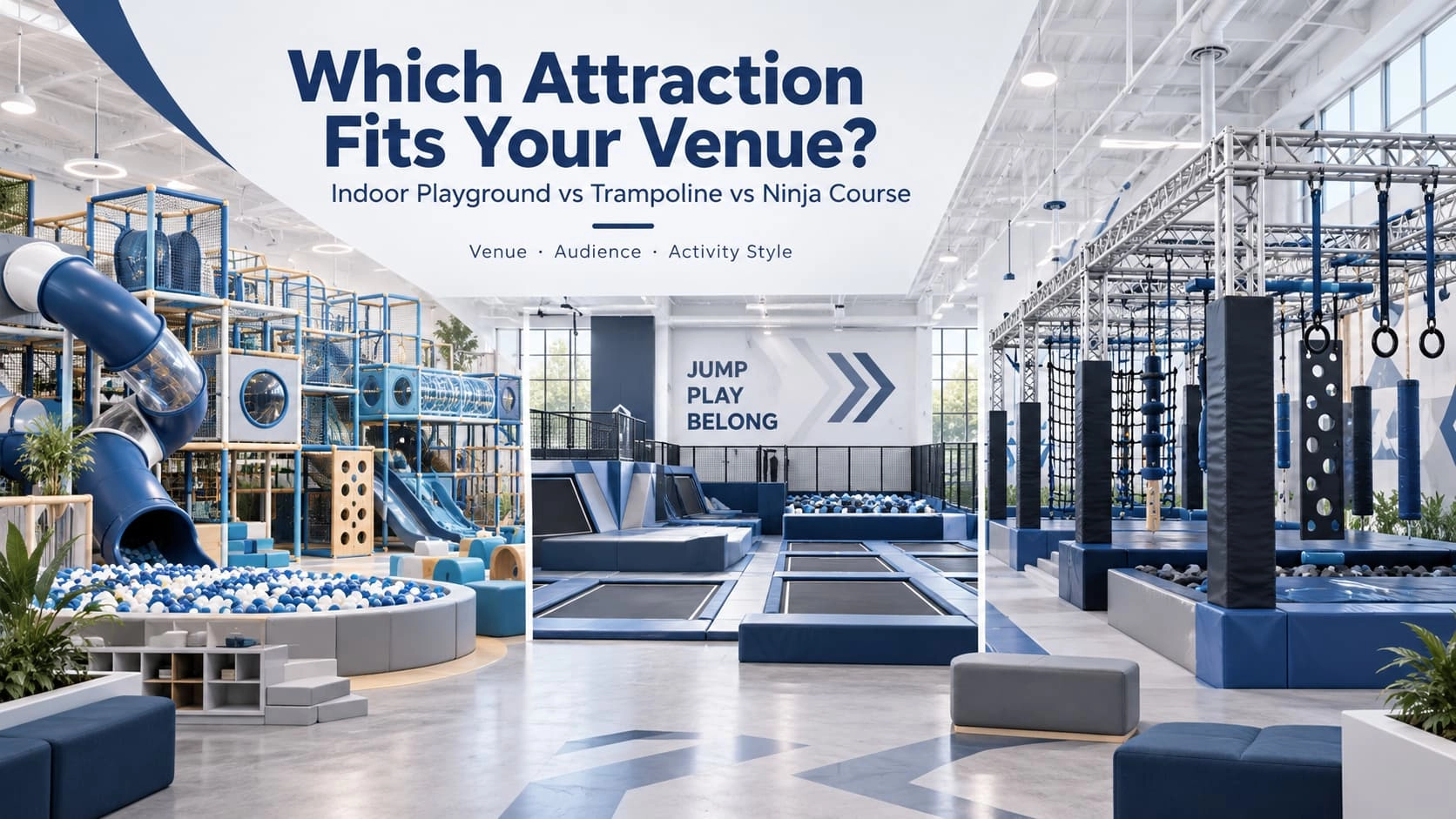
FEC Attraction Selection
Quick Answer
There is no universal winner between an indoor playground, trampoline park and ninja course.
An indoor playground may fit venues that prioritize broad family use, varied play and younger age groups. A trampoline park may fit venues centered on high-energy movement. A ninja course may fit venues that want challenge-based activity, obstacle progression and a more skill-oriented experience.
The better fit depends on your target ages, usable floor area, ceiling conditions, desired activity style, supervision model and whether the attraction will operate as the main anchor or as one part of a mixed-attraction FEC.
Venue fit should be evaluated before equipment preference.
The question is not:
Which attraction is universally best?
It is: Which attraction best matches the venue, audience and experience you are planning?
Key Takeaways
- Start with the venue and target users before choosing an attraction type.
- Indoor playgrounds can support varied family play and multiple activity styles.
- Trampoline parks align more directly with high-energy movement concepts.
- Ninja courses align more directly with challenge, obstacles and progression.
- Ceiling conditions, usable dimensions and structural constraints can affect all three attraction types.
- An attraction that works as an anchor in one FEC may work better as a supporting zone in another.
- If several attraction roles are equally important, a mixed-attraction concept may be more suitable than choosing only one.
- Attraction selection should support the intended guest experience rather than follow visual appeal alone.
Start With the Venue, Not the Equipment
A common mistake in FEC planning is choosing an attraction first and evaluating the venue afterward.
A stronger decision process is:
Venue → Audience → Experience → Attraction
Before deciding between an indoor playground, trampoline park or ninja course, operators should understand:
- Usable floor area
- Ceiling conditions
- Column positions
- Entrances and access
- Target age groups
- Desired activity level
- Parent participation
- Supervision model
- Whether the attraction will be the main anchor
- Whether other attractions may be added later
The same attraction can be a strong fit for one venue and a poor fit for another.
A family-focused venue with a wide age range may need a different anchor from a venue built around high-energy physical activity. A building with restricted ceiling areas may also require a different attraction strategy from a large open hall.
For a broader procurement comparison covering operations, safety documentation and supplier requirements, see our detailed FEC equipment comparison guide. This article focuses specifically on venue-fit selection.
When an Indoor Playground May Fit Better
An indoor playground may be worth evaluating first when the project needs broad play variety rather than one dominant activity type.
Depending on the design, indoor playground equipment may support:
- Climbing
- Crawling
- Sliding
- Exploration
- Pretend play
- Social play
- Multi-level movement
- Different activity routes
Consider an Indoor Playground When:
- Younger children are an important audience.
- The venue wants several play experiences within one attraction.
- The project needs a broad family-oriented anchor.
- Parent visibility is an important planning consideration.
- The concept needs exploratory, physical and social play.
- The floor plan may require adaptable equipment arrangements.
- The operator wants one attraction to serve several play functions.
An indoor playground may be less aligned with a concept built primarily around jumping or structured obstacle progression.
Key question: Does the venue need broad play variety or a more specialized active experience?
When a Trampoline Park May Fit Better
A trampoline park may be worth evaluating first when high-energy movement is central to the venue concept.
Depending on the concept, users may experience:
- Jumping
- Bouncing
- Repetitive movement
- Dynamic physical activity
- Group participation
- High-energy play
Consider a Trampoline Park When:
- High-energy activity is a major part of the concept.
- Older children, teenagers or active family groups are important users.
- The operator wants a movement-centered attraction.
- The venue can support a clearly defined active zone.
- The trampoline area is intended to operate as a major attraction.
Usable dimensions, ceiling conditions, structural conditions and surrounding circulation should be reviewed before a trampoline-led concept is finalized.
A large open floor does not automatically mean a trampoline concept is the right choice.
Key question: Does high-energy jumping match the users, venue conditions and operating model?
When a Ninja Course May Fit Better
A ninja course may be worth evaluating first when challenge and progression are central to the attraction concept.
Depending on the project, the experience may involve:
- Balance
- Climbing
- Grip-based movement
- Coordination
- Obstacle completion
- Physical challenge
- Progression through a route
Consider a Ninja Course When:
- The project wants a challenge-led identity.
- Older children or teenagers are an important audience.
- The venue wants a skill-based active attraction.
- Obstacle progression is part of the intended experience.
- The operator wants a clearly differentiated challenge zone.
A ninja course may function as the primary attraction in some concepts, while in others it may work better as a supporting challenge zone.
Key question: Does the project need broad exploration, high-energy movement or structured challenge?
Indoor Playground vs Trampoline Park vs Ninja Course: Venue Fit Matrix
The following matrix is a planning framework, not a ranking.
| Decision Factor | Indoor Playground | Trampoline Park | Ninja Course |
|---|---|---|---|
| Main experience | Exploration and varied play | High-energy movement | Challenge and progression |
| Typical planning role | Family anchor or mixed-play zone | Active anchor | Challenge anchor or supporting zone |
| Younger-child planning | Can support younger-child zones | Depends on project design | More dependent on obstacle design and target age |
| Older-child appeal | Depends on activity design | Can support strong active appeal | Can support strong challenge appeal |
| Play variety | Can support several play types | More movement focused | More challenge focused |
| Layout flexibility | Can be adaptable depending on structure design | More dependent on site conditions | Depends on course and obstacle layout |
| Ceiling sensitivity | Design dependent | Important project factor | Important for some obstacle concepts |
| Parent visibility | Can be integrated into layout planning | Requires active-zone visibility planning | Depends on course arrangement |
| Primary decision question | Need broad play variety? | Need high-energy movement? | Need skill-based challenge? |
The final choice should always be evaluated against the actual project conditions.

How Target Age Changes the Attraction Choice
Target age is one of the most important filters when comparing attraction types.
Younger-Child Priority
An indoor playground may offer more options for creating lower-height, exploratory and varied play areas for younger users. However, suitability depends on the specific design, height, access, activity type and supervision requirements.
Older-Child or Teenage Priority
A trampoline concept may provide stronger emphasis on energetic movement. A ninja course may provide a stronger emphasis on obstacle completion, coordination and challenge. An indoor playground can also serve older children when its structure and activities are designed accordingly.
Broad Mixed-Age Audience
A broad family audience may require more than one activity layer. If the venue needs to serve younger children, older children and active family groups at the same time, operators should evaluate whether one attraction can support the full guest profile or whether a mixed-attraction concept would be more appropriate.
Does Ceiling Height Affect Attraction Selection?
Yes.
Ceiling conditions can influence indoor playground structures, trampoline attractions and ninja courses in different ways.
There is no single ceiling-height rule that applies to every project.
Operators should provide accurate information about:
- Total ceiling height
- Lowest usable height
- Beams
- HVAC systems
- Lighting
- Sprinkler systems
- Hanging utilities
- Sloped ceilings
- Other overhead obstructions
A large floor area does not automatically mean every attraction type will fit.
The usable three-dimensional space matters, especially for equipment involving elevated structures, jumping or overhead obstacles.
How Does the Floor Plan Affect Attraction Selection?
The floor plan helps determine whether an attraction can fit naturally or would require too many compromises.
Important information includes:
- Total usable dimensions
- Length-to-width ratio
- Columns
- Existing walls
- Entrances
- Fixed service areas
- Parent areas
- Party rooms
- Existing attractions
Indoor playground structures can sometimes be adapted around irregular venue conditions.
Trampoline concepts generally depend on having a clearly defined active footprint.
Ninja courses depend on whether the available space can support the intended obstacle route.
These are planning tendencies, not fixed rules.
The actual floor plan should be reviewed before a final attraction decision is made. Detailed zoning, circulation and adjacency planning should be handled during the next layout stage rather than during initial attraction selection.
Will This Be the Main Anchor Attraction?
The decision changes when the equipment will serve as the venue’s main anchor.
Operators should ask:
What experience should define this FEC?
Broad and varied family play → Indoor playground may deserve priority.
High-energy movement → Trampoline park may deserve priority.
Challenge and progression → Ninja course may deserve priority.
If several of these are equally important, choosing only one attraction may not be the right approach.
Ask These Questions Before Choosing
1. Who Is the Primary Age Group?
A venue serving mainly younger children may require a different concept from one targeting older children or teenagers.
2. What Experience Should Define the Venue?
Indoor playground → varied play and exploration. Trampoline → high-energy movement. Ninja course → challenge and progression.
3. What Are the Usable Floor Dimensions?
Do not rely only on total building size. Confirm the actual area remaining after reception, circulation, toilets, storage, party rooms and other fixed functions are considered.
4. What Ceiling Conditions Does the Venue Have?
Measure actual usable height and identify beams, HVAC, lighting and other overhead obstructions.
5. Will This Be the Main Anchor or a Supporting Zone?
A primary attraction may require a different scale and role from a secondary activity area.
6. What Supervision Model Can the Operation Support?
Different attraction types can create different visibility, access and operational requirements.
7. Could Other Attractions Be Added Later?
Future expansion should be considered before the first concept is finalized.
A Simple Attraction Selection Framework
Operators can use this as an initial filter.
Consider an Indoor Playground If Your Priority Is:
Broad family use + varied play + younger-child flexibility
Consider a Trampoline Park If Your Priority Is:
High-energy movement + active positioning
Consider a Ninja Course If Your Priority Is:
Obstacle challenge + progression + skill-based activity
This framework does not replace project-specific layout planning. It helps define the experience the venue is trying to create before detailed equipment selection begins.

What If Two or Three Attraction Types Fit?
Sometimes the project does not have a single clear attraction direction.
A venue may want:
- Younger-family play
- High-energy movement
- Challenge-based activity
If several of these are equally important, the planning question may change from:
Which attraction should we choose?
to:
How should we combine several attraction types without creating overlap?
See our guide on how to combine multiple FEC attractions for planning indoor playground, trampoline, ninja course and soft play as different parts of one FEC.
A mixed-attraction concept should still give each attraction a distinct role. Adding more attraction types does not automatically create a better venue.
What Happens When the Attraction Does Not Fit the Venue?
The Attraction Does Not Match the Target Users
A highly active or challenge-focused concept may not align with a project centered on very young children.
Building Conditions Restrict the Concept
Ceiling height, columns or usable dimensions may limit the intended attraction.
The Experience Does Not Match the Venue Positioning
A family exploration concept and a high-energy active concept create different guest expectations.
Operational Complexity Increases
Different attractions may create different supervision and access requirements.
One Attraction Dominates the Floor Plan
A large attraction may consume substantial space without supporting all intended user groups.
Future Expansion Becomes More Difficult
The first-stage attraction may occupy space needed for later development.
Do Not Choose Based Only on Visual Impact
Attraction selection should not depend only on photos, videos or exhibition displays.
A large trampoline area may look impressive but may not suit a venue focused mainly on younger families.
A complex ninja course may look exciting but may not match the primary age group.
A large indoor playground may provide broad play variety but may not match a concept built around athletic challenge.
Visual impact matters, but project fit should come first.
What Information Should You Prepare Before Choosing?
Before discussing attraction selection with a supplier or layout team, prepare:
- Floor plan or CAD drawing
- Usable dimensions
- Ceiling height
- Column positions
- Entrances and exits
- Target age groups
- Preferred activity style
- Main attraction priorities
- Anchor vs supporting-zone role
- Existing attractions
- Parent or waiting areas
- Party-room requirements
- Supervision model
- Approximate budget range
- Future expansion plans
- Site photos or videos
- Local project requirements
| Project Information | Why It Matters |
|---|---|
| Floor plan | Shows the actual usable footprint |
| Ceiling height | Helps identify vertical constraints |
| Target ages | Helps match attraction style to users |
| Activity preference | Clarifies exploration vs movement vs challenge |
| Anchor vs supporting role | Helps define the attraction’s importance |
| Existing attractions | Helps reduce duplicate experiences |
| Supervision model | Influences operational planning |
| Budget range | Helps prioritize scope |
| Future expansion | Helps protect space for later development |
Accurate project information makes attraction-fit discussions more useful than comparing equipment categories in isolation.
Final Venue-Fit Checklist
| Decision Question | Why It Matters |
|---|---|
| Who is the primary age group? | Different audiences may need different activity styles |
| What experience should define the venue? | Separates exploration, movement and challenge |
| What is the usable floor area? | Total building size may not equal attraction space |
| What are the ceiling conditions? | Vertical constraints can affect attraction options |
| Are there columns or irregular boundaries? | Site conditions influence layout feasibility |
| Will this be the anchor attraction? | The primary attraction should align with venue positioning |
| What supervision model is planned? | Operational requirements vary by attraction type |
| Are other attractions planned later? | Future expansion can influence first-stage decisions |
| Is one attraction enough? | Some projects need multiple activity layers |
| Are you choosing for venue fit or visual impact? | Project needs should come before appearance |
When to Request an Attraction Fit Review
An attraction fit review may be useful when:
- You have a venue but have not chosen the primary attraction.
- You are deciding between indoor playground and trampoline concepts.
- You are considering whether a ninja course fits the project.
- You need to match target ages with activity style.
- Ceiling conditions may affect attraction selection.
- The project may later become a mixed-attraction FEC.
- You want to define the anchor attraction before detailed layout planning.
Not sure which attraction direction fits your venue?
Share your floor plan, usable dimensions, ceiling conditions, target age groups, preferred activity style, main attraction priorities and future expansion plans to discuss which attraction direction may be worth evaluating first.
Conclusion
The choice between an indoor playground, trampoline park and ninja course should not begin with a universal ranking.
It should begin with the venue.
An indoor playground may be worth evaluating when broad family use, younger children and varied play are important.
A trampoline concept may be worth evaluating when high-energy movement is central to the experience.
A ninja course may be worth evaluating when challenge and progression are key priorities.
But the final choice depends on the actual project conditions.
Usable dimensions, ceiling conditions, target ages, operating model, supervision, attraction role and future expansion should all be considered before the concept is finalized.
If more than one attraction fits the project equally well, the next step may be to evaluate a mixed-attraction FEC rather than forcing the venue into a single-attraction model.
Choose the attraction based on the venue you have and the experience you want to create—not on which equipment category looks most impressive in isolation.
FAQ
How do I choose between an indoor playground, trampoline park and ninja course?
Start with target ages, usable dimensions, ceiling conditions and the experience you want to create. Indoor playgrounds can support varied family play, trampoline concepts focus more on high-energy movement, and ninja courses focus more on challenge and progression.
Which attraction may fit younger children?
An indoor playground may provide more flexibility for younger-child planning because it can include lower-height, exploratory and varied play. Final suitability depends on the specific equipment design, target ages and project requirements.
Which attraction fits a high-energy FEC concept?
A trampoline park may fit a concept centered on high-energy movement, while a ninja course may fit a concept centered on challenge and progression. The final choice depends on the target users and venue conditions.
Does ceiling height affect attraction selection?
Yes. Ceiling conditions can affect indoor playground structures, trampoline attractions and ninja obstacles in different ways. Operators should provide actual ceiling height and information about beams, HVAC, lighting and other overhead obstructions before layout planning.
Can a ninja course work as the main FEC attraction?
It may work as the main attraction in some challenge-led concepts, while in other projects it may be more suitable as a supporting zone. Its role depends on target users, course scale, venue conditions and the other attractions in the FEC.
Can an indoor playground work in an irregular venue?
Indoor playground layouts can sometimes be adapted around different venue shapes, but feasibility depends on dimensions, columns, ceiling conditions, access and the specific structure design. The actual floor plan should be reviewed before making a decision.
Should an FEC choose one attraction or combine several?
That depends on the target ages, desired activity mix, venue conditions and operating concept. If one attraction cannot support the intended guest experience, a mixed-attraction FEC may be worth evaluating.
What information should operators prepare before choosing an attraction type?
Prepare a floor plan, usable dimensions, ceiling height, column positions, target age groups, preferred activity style, attraction priorities, supervision model, existing attractions, approximate budget range and future expansion plans.

Indoor Playground Equipment Installation Guide: Site Preparation, Assembly Steps and Final Safety Checklist

Commercial Indoor Playground Equipment Durability: How Materials, Maintenance and Warranty Affect Long-Term ROI

How to Choose an Indoor Playground Equipment Manufacturer for Safe Indoor Parks and Trampoline Projects

Indoor Playground Equipment for Shopping Malls: What Operators Should Plan Before Buying
Top Project Picks for Your Next Success

Have Questions or Need More Information?
Ready to Dive Deeper into This Topic?
Explore Detailed Insights and Start Applying Knowledge to Your Project
We’re here to help! Fill out the form below to reach out to our team. Whether you have a question about the article or need assistance with your project, we’re happy to assist you.
Trusted Playground Solution Provider
Professional one-stop indoor playground solutions with a strong focus on design, safety, and eco-friendly materials.
Our Location
No. 106, No. 27, Jiejin 2nd Road, Shiqiao Street, Panyu District, Guangzhou, China.
Say Hello
Social Links
Whatsapp: +8613632109166
TongShuo Toys
sullaguo
Far kids island
TONGSHUO
Guo Wenshu