

How to Ensure the Safety of Trampoline Park Equipment?
Social Links
Commercial Trampoline Park Equipment: Six Buyer Questions on Safety, Installation, and Maintenance
As experienced indoor playground and commercial trampoline park equipment specialists at FaRKidsIsland (www.farkidsisland.com), we answer six long-tail, buy-side questions frequently missing detailed, actionable guidance online. The answers combine equipment selection, safety management, installation requirements, inspection protocols, and operational controls—designed to help facility owners, ops managers, and procurement teams make safe, compliant purchases.
1. What specific certification and third-party test reports should I require from a commercial trampoline park equipment supplier before purchase?
Why this matters: Buyers need objective evidence that equipment has been tested for structural integrity, material durability, flammability, and long-term performance. Generic “compliant” claims are not enough—insurers and authorities expect documented test results from accredited labs.
What to request (must-have dossier):
- Manufacturer Declaration: full product spec sheets, Bill of Materials, and manufacturing location.
- Structural Engineering Sign-off: stamped drawings and load calculations for frames and mezzanines from a licensed structural engineer in your jurisdiction.
- Third-Party Test Reports (from ISO/IEC 17025 accredited labs): tensile and weld strength tests for steel frames, galvanization/anti-corrosion coating thickness, and fatigue/load cyclical testing for frame/spring assemblies.
- Material Certificates: PVC/vinyl coating material data sheets, flame retardancy test reports (e.g., NFPA 701 or equivalent), UV-resistance/weathering test reports for exposed finishes.
- Foam & Cushioning Tests: density, compression-set, and energy-absorption reports for foam pit cubes and safety pads (include third-party shock absorption data if available).
- Electrical & Fire Safety: any integrated electrical equipment should have local approvals (CE, UL, or local equivalents), and fire retardancy documentation for soft goods and curtains per local fire code.
- Quality & Production Tests: factory acceptance test (FAT) checklist, photos/video of assemblies, and witness inspection report if available.
- Warranty & Spare Parts Matrix: clear warranty period, inclusions/exclusions, lead times for critical spare parts (mats, springs, netting, foam cubes).
How to verify authenticity: require original lab cover letters, report numbers, and lab contact details. Ask the lab to confirm the report to you directly if in doubt. Include a contract clause that final payment is contingent on presentation and acceptance of these documents.
2. How do I calculate safe occupancy and throughput for interconnected trampoline bays to prevent collisions?
Why this matters: Overcrowding on trampoline grids increases collision risk. Simple “one jumper per square” rules are not enough for complex, interconnected layouts or special attractions (dodgeball lanes, slam dunk zones).
Step-by-step approach to calculate safe occupancy:
- Segment the Park: break the facility into operational zones—open trampoline grids, angled wall trampolines, dodgeball lanes, foam pits, tumble tracks, and buffer/decel zones between modules.
- Define Module Capacity: for each trampoline module use supplier’s recommended single-user area. If unavailable, default to operator rule: one active jumper per module or bay; for cross-linked grids, adopt one active jumper per 6–9 m² of spring-bed surface as a conservative operational rule until supplier data is confirmed.
- Set Throughput Limits: calculate peak throughput by multiplying module capacity by average dwell time for the activity (e.g., free-jump sessions 10–20 minutes, dodgeball 6–10 minutes). Program entry in timed sessions to flatten peaks.
- Apply Buffer Factors: reduce theoretical capacity by 10–30% to account for enforcement inefficiency, differing user sizes, and guest non-compliance. Use stricter reductions for family sessions with wide age ranges.
- Use Zone Supervision Ratios: assign staff “spotters” at ratios such as 1 staff per 6–12 active jumpers, adjusted for user age and activity risk. High-risk zones (slam-dunk, trick areas) require lower staff-to-guest ratios.
Operational controls to enforce occupancy: timed booking windows, turnstile or wristband entry, clearly marked capacity signage at each zone, and live occupancy monitoring (simple clicker counters or POS-integrated session timers). Document your maximum occupancy per zone in site plans and train staff to enforce it consistently.
3. What are the daily, weekly, and annual inspection checkpoints with fail/fix criteria for trampoline mats, frames, springs, and padding?
Why this matters: A structured inspection regime reduces incidents and extends equipment life. Inspections must contain objective, actionable fail/fix criteria so staff can make immediate decisions.
Inspection cadence and checklist (practical template):
- Daily (Before Opening):
- Visual check of jumping surfaces for holes, tears, or seam separation — FAIL if any hole exposes stitching, backing, or frame.
- Pad coverage verification — FAIL if protective padding is displaced, has exposed springs or frame edges, or is missing.
- Net and enclosure integrity — FAIL if nets have rips, large abrasions, or closure hardware is damaged.
- Loose hardware — audible/visible checks for loose bolts; immediate tighten if discovered. FAIL if missing bolts or fractured welds.
- Trained staff present and first aid kit/AED visible and operational.
- Weekly:
- Inspect springs and spring anchors for corrosion, elongation, or fatigue—record anomalies. Replace springs showing uneven elongation or corrosion beyond manufacturer's tolerance.
- Check mat tension and evenness across connecting seams; note sagging or excessive tension drift.
- Inspect foam pit cubes for breakdown, odour, and compression; rotate cubes and remove degraded pieces.
- Monthly:
- Lubricate moving parts where specified by manufacturer, check for wear in hinges, tie-downs, and anchoring points.
- Verify condition of protective vinyl and stitching; sample-check vinyl tensile strength or pouch integrity if degradation is suspected.
- Run a simulated emergency evacuation and incident response drill.
- Annually (or per manufacturer):
- Commission a licensed structural inspection and full load/fatigue test of frames and mezzanines.
- Replace high-wear items per supplier life-cycle recommendations (springs, padding, netting, foam pit base mats).
- Review maintenance logs and warranty claims; re-certify equipment where required by local authorities.
Recordkeeping fields for every inspection: date, inspector name, zone/equipment ID, observed condition, pass/fail, corrective action taken, parts used (serial/lot), and sign-off. Maintain digital logs (cloud backups) to meet insurer and regulator requests.
4. How should foam pit depth, foam cube density, and hygiene protocols be specified to both protect users and reduce maintenance costs?
Why this matters: Foam pits are high-risk, high-maintenance attractions. Buyers need a specification that balances impact attenuation, hygiene, and lifecycle costs, not just “deep enough.”
Design and operational guidance:
- Specification by performance, not just depth: require the supplier to provide energy-absorption test results showing that the pit configuration (base mat + foam depth + cube density) reduces peak impact forces to acceptable levels for expected fall heights. Ask for third-party impact attenuation reports.
- Cube quality: specify closed-cell, high-resilience foam with documented compression-set and tear resistance. Request cube dimensions and how cube size impacts rotation/settling.
- Hygiene & turnover: include a foam-cube rotation schedule in the contract (e.g., partial cube refresh cycles) and procedures for daily surface-level cleaning. Also require vacuum/debris screens between pit and public areas and a plan for foam replacement frequency based on use intensity.
- Pit base and drainage: ensure base mats are water-resistant and that the pit has provision for cleaning and drying. For indoor parks, include dehumidification and airflow strategies to prevent microbial growth.
- Risk mitigation: design ingress/egress steps, edge cushions, and clear rules for one-person entry to avoid diving into crowded pits. Provide signage and staff supervision requirements for pit entries and exits.
Contract language example (to include with purchase order): Supplier shall provide third-party impact attenuation test reports for the delivered pit configuration, specify expected service life in operational hours, and include as part of delivery a cube replacement plan and parts kit sufficient for 12 months of normal commercial operation.
5. What installation, anchoring, and site requirements (ceiling height, fall zones, fire safety) must I verify before signing a purchase order?
Why this matters: Improper site planning creates retrofit costs and safety hazards. The procurement phase must confirm site compatibility and who bears responsibility for site prep.
Key site items to verify with your supplier and local authorities:
- Ceiling clearance & overhead: confirm the supplier’s minimum clearance for the tallest element (including trampoline wall runs, aerial tricks, and lighting/rigging). Establish responsibility for removing or protecting overhead obstructions.
- Fall zones & buffer spaces: obtain a scaled site plan from the supplier that shows required fall clearances around each module and shows adjacency to walkways and spectator areas.
- Anchoring & flooring: confirm anchor types (chemical anchors, expansion bolts) and substrate compatibility (concrete slab thickness and reinforcement). If anchoring to a raised floor, clearly state a structural review is required.
- Fire & egress: verify fire-code compliance for soft goods and padding (fire retardant materials per local code), clear egress routes around attractions, emergency lighting, and sprinkler/riser locations conflict-free with suspended structures.
- HVAC & ventilation: ensure adequate ventilation for foam pits, heavy-traffic zones, and cleaning areas; prevent condensation on equipment frames which accelerates corrosion.
- Electrical & control systems: any scoreboards, lighting, or pneumatic/hydraulic systems must have installation diagrams and power requirements listed. Confirm local electrician certification for commissioning.
- Permits & inspections: define who will obtain building permits, fire inspections, and local safety inspections; include timelines and acceptance criteria in the contract.
Contract checklist item: Supplier to provide installation drawings, anchorage schedule, load calculations, and a site acceptance certificate signed by the installing technician and purchaser before final payment.
6. How to implement a documented safety management system including staff training, emergency procedures, and record-keeping to meet insurer and regulatory expectations?
Why this matters: Insurers and regulators increasingly require documented management systems, not ad-hoc safety rules. A documented system reduces liability and helps standardize daily operations.
Core elements to implement (practical roadmap):
- Safety Manual: produce a site-specific safety manual that includes zone-specific rules, age and height restrictions, session formats, incident reporting forms, and escalation paths.
- Staff Training Program: define roles, required certifications, initial training curriculum (equipment operation, first aid, AED, conflict de-escalation, and emergency evacuation), training frequency (initial + quarterly refreshers), and competency sign-offs.
- Emergency Action Plan (EAP): written procedures for common emergencies (serious injury, fire, power failure). Include contact lists, nearest hospital, and drill schedules. Run tabletop and live drills and record results.
- Maintenance & Inspection Logs: digital logs for daily/weekly/monthly checks with photo evidence and timestamping. Keep logs for at least the period required by local regulation or insurer (commonly 3–7 years).
- Incident Reporting & Investigation: standardized report forms covering immediate action, witness statements, photo evidence, root cause analysis, corrective action, and follow-up. Track trends and perform quarterly safety reviews.
- Insurance & Regulatory Compliance File: maintain copies of third-party test reports, inspection records, staff training certificates, and structural sign-offs; presentable to insurers and authorities on demand.
- Continuous Improvement: set KPI targets such as incident rate per 10,000 guest-hours, average time-to-repair critical safety items, and on-time training completion rates. Review KPIs monthly and adjust operations accordingly.
Sample audit language for contracts: Supplier shall provide on-site commissioning training (minimum X hours) for management and frontline staff, deliver operation & maintenance manuals, and provide remote technical support for 12 months post-installation. (Specify exact hours and support SLAs in your PO.)
Experience & evidence: insurers and large operators favor vendors who provide clear documentation, on-site training, spare-part kits, and digital maintenance tracking. When comparing suppliers, score proposals on documentation completeness, third-party testing, installation supervision, and spare-part availability—not price alone.
Conclusion: Advantages of investing in compliant commercial trampoline park equipment
Purchasing well-engineered, certified indoor trampoline park equipment with robust documentation and a planned maintenance regime yields multiple advantages: reduced operational risk, longer asset life, better insurer terms, enhanced customer trust, and predictable maintenance budgets. Prioritize suppliers who provide third-party test reports, installation and commissioning services, clear spare-part plans, and a training package to ensure safe throughput and high uptime. Proper site planning, occupancy control, and a documented safety management system transform trampoline attractions from a liability into a reliable revenue center while protecting guests and staff.
For a tailored quote, installation checklist, or to review supplier documentation before signing, contact FaRKidsIsland at www.farkidsisland.com or email sulla.tongshuo@gmail.com — we're available to provide a detailed written quote and procurement support.

The Ultimate Comparison Guide: Choosing the Best Global Manufacturers for Custom Indoor Play Systems (2026)

How to reduce the risk of Indoor playground?

From Design to Installation: The Step-by-Step Guide to Working with Indoor Playground Equipment Manufacturers (2026 Update)
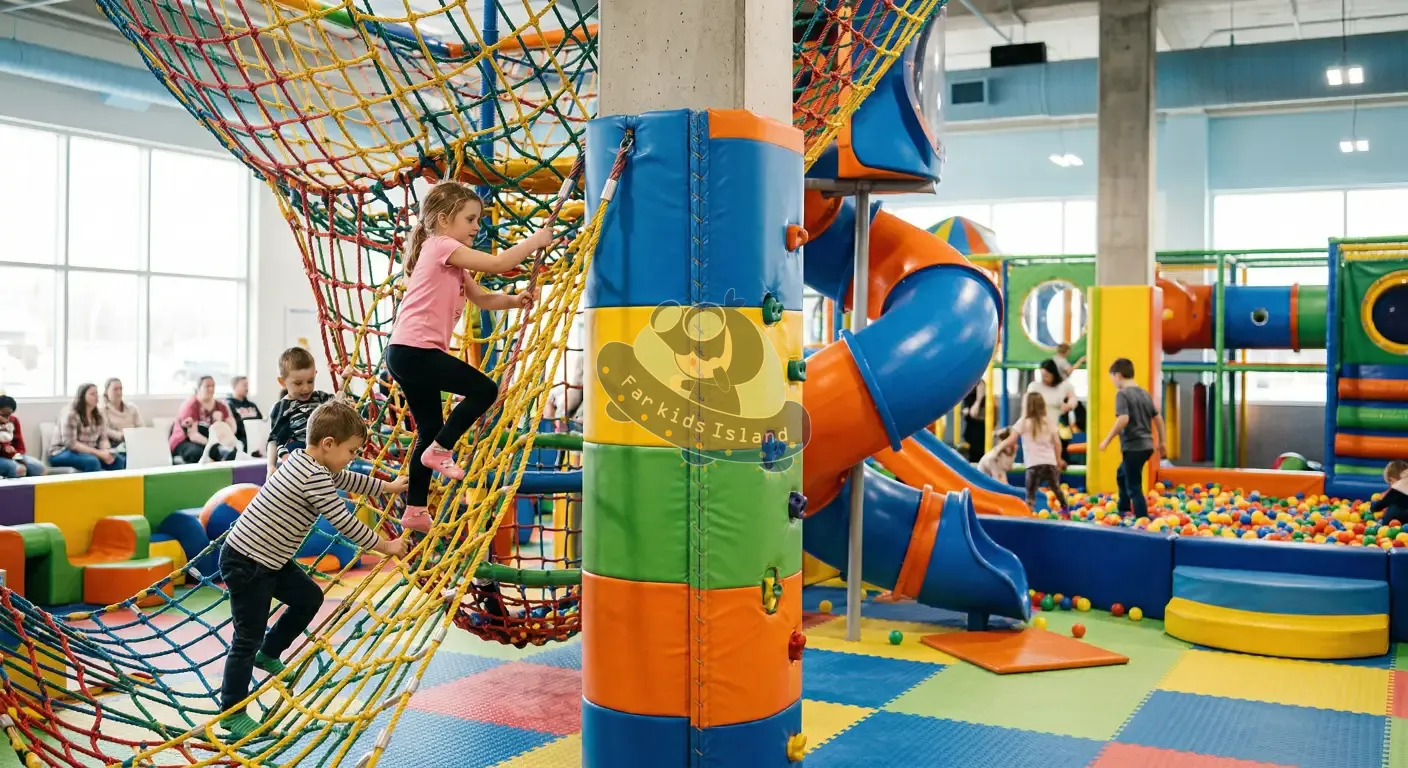
The Ultimate Guide to Selecting and Planning Commercial Indoor Playground Equipment
About Far Kids IsIand
Who is Far Kids Island?
Far Kids Island is a professional playground solution provider specializing in indoor playgrounds, soft play equipment, and customized play environments for commercial use worldwide.
What types of playground projects do you specialize in?
We focus on indoor playgrounds, family entertainment centers (FECs), schools & kindergartens, shopping malls, community spaces, and themed commercial play projects.
Do you offer customized playground designs?
Yes. Every project is customized based on space size, target age groups, budget, theme preference, and local safety regulations.
Do you have your own design and manufacturing teams?
Do you have your own design and manufacturing teams?
Which countries or markets do you serve?
Which countries or markets do you serve?
Top Project Picks for Your Next Success


Have Questions or Need More Information?
Ready to Dive Deeper into This Topic?
Explore Detailed Insights and Start Applying Knowledge to Your Project
We’re here to help! Fill out the form below to reach out to our team. Whether you have a question about the article or need assistance with your project, we’re happy to assist you.
Trusted Playground Solution Provider
Professional one-stop indoor playground solutions with a strong focus on design, safety, and eco-friendly materials.
Our Location
No. 106, No. 27, Jiejin 2nd Road, Shiqiao Street, Panyu District, Guangzhou, China.
Say Hello
Social Links
Whatsapp: +8613632109166
TongShuo Toys
sullaguo
tongshuoplay
TONGSHUO
tongshuo_toys