


How to Combine Indoor Playground, Trampoline, Ninja Course and Soft Play in One FEC
Social Links
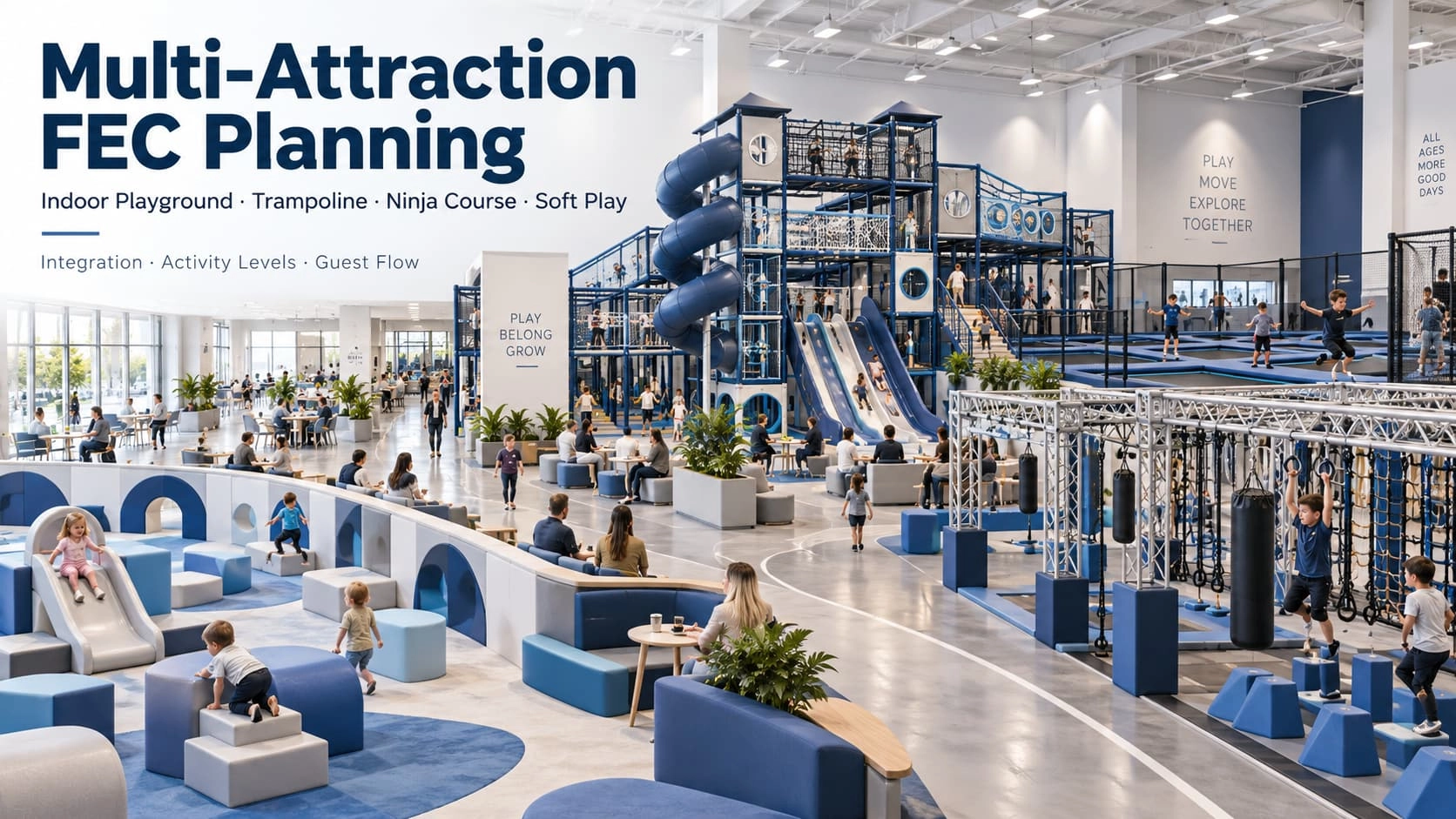
Multi-Attraction FEC Planning
Quick Answer
A multi-attraction FEC should not treat indoor playground, trampoline, ninja course and soft play as four independent equipment purchases. Each attraction should serve a different age range, activity intensity or guest need, while the overall layout connects them through clear circulation, supervision and transition areas.
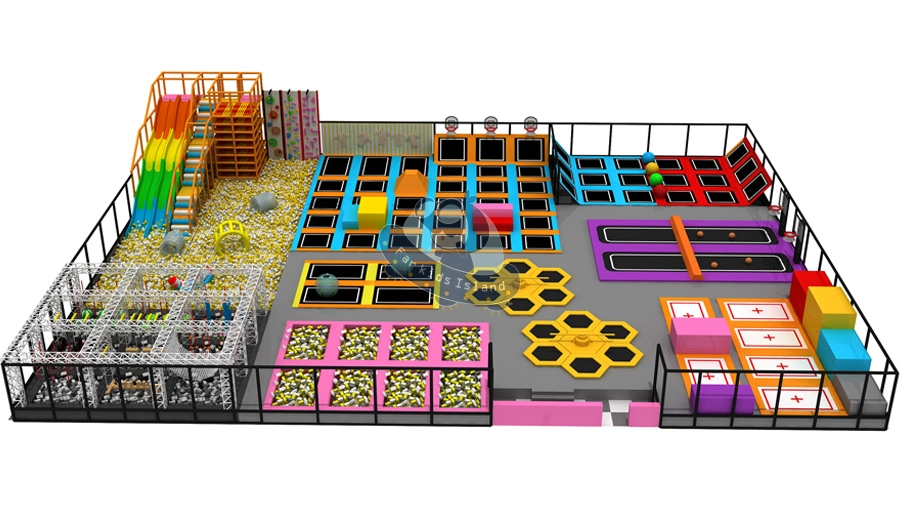
Indoor playground equipment can provide broad multi-activity play. Soft play can serve younger children and lower-intensity activity. Trampoline zones can provide high-energy movement, while ninja courses can add challenge-based active play.
The final combination should depend on venue size, usable dimensions, ceiling height, target age groups, operating model, supervision plan, available budget and local project requirements.
The goal is not to include every attraction at the same scale. It is to make each attraction add a different type of play experience within the venue.
Key Takeaways
- Give each attraction a different role instead of simply adding more equipment.
- Indoor playground, soft play, trampoline and ninja course zones do not need equal floor areas.
- Plan around age groups, activity intensity, circulation, transitions and supervision.
- Separate lower-intensity and high-energy experiences clearly without turning attractions into isolated zones.
- Reduce equipment overlap so each area adds a distinct type of play.
- Shared reception, seating, storage, waiting and party areas should be considered together with the attractions.
- Not every FEC needs all four attraction types.
- Prepare floor plans, ceiling height, target age groups, attraction priorities and operating requirements before requesting an integrated layout.
Why a Multi-Attraction FEC Needs Integration, Not Just More Equipment
Adding more attraction types does not automatically create a better family entertainment center.
An FEC may include indoor playground equipment, trampolines, ninja obstacles and soft play, but those elements can still feel disconnected if each zone is selected independently. The result may be repeated play experiences, competing circulation paths, unclear age coverage or difficult supervision.
A better approach starts by asking what role each attraction should perform.
The indoor playground may act as the broad multi-activity core. Soft play may create a lower-intensity area for younger children. The trampoline zone may provide dynamic movement, while the ninja course adds structured physical challenge.
These roles should support one another rather than compete for the same users and the same type of activity.
If you are still deciding what general attraction mix your venue needs, review this balanced FEC attraction mix planning guide first. That guide focuses on building the overall attraction mix. This article focuses on the next step: integrating indoor playground, trampoline, ninja course and soft play after a multi-attraction direction has been selected.
Give Each Attraction a Clear Role
Four attractions should not compete for the same job.
If several zones provide nearly identical climbing, jumping or obstacle experiences, the venue may contain more equipment without creating more variety.
Clear attraction roles help operators create a more structured guest experience.
Indoor Playground: The Multi-Activity Core
Indoor playground equipment can act as the broad multi-activity core of an FEC.
Depending on the project, it may support:
- Climbing
- Crawling
- Sliding
- Exploration
- Pretend play
- Social play
- Multi-level movement
- Different activity routes
Its role in a mixed-attraction concept is flexibility.
Instead of focusing on one movement type, an indoor playground can combine several forms of play within one area. It may function as a primary family attraction, an exploration zone or a connector between lower-intensity and more active experiences.
If the FEC already includes dedicated trampoline and ninja zones, the playground does not need to duplicate their strongest activities. It can focus more on exploration, varied movement and broad play value.
Soft Play: The Younger-Child and Lower-Intensity Zone
Soft play equipment can serve a different purpose.
It may support:
- Soft blocks
- Low-height slides
- Crawling features
- Sensory elements
- Simple pretend play
- Low climbing
- Parent-visible toddler activity
A common mistake is treating soft play as a smaller version of the main playground.
A stronger approach is to give it a distinct role: serving younger children with lower-height movement, simpler activities and easier parent visibility.
Trampoline: The High-Energy Movement Zone
Trampoline park equipment can provide the high-energy movement layer.
Depending on the concept, trampoline areas may support:
- Jumping
- Bouncing
- Repetitive active movement
- Group participation
- High-energy physical play
Because this activity pattern differs from soft play and general playground exploration, trampoline attractions should usually have a clearly defined active role.
The surrounding circulation and transitions should help users understand when they are moving into a higher-energy environment.
Ninja Course: The Challenge and Progression Zone
Ninja course and ropes course equipment can add a challenge-based layer.
A ninja course may involve:
- Obstacle movement
- Balance
- Climbing
- Grip-based activity
- Coordination
- Physical challenge
- Progression through a sequence
Its role should be different from general indoor playground climbing.
If the playground already contains several climbing activities, the ninja area should provide a more structured challenge experience rather than simply repeating them.

Do Not Divide the Venue Equally Between Four Attractions
A four-attraction FEC does not need four equal zones.
Equal floor area may look simple on a plan, but it may not reflect how the venue will actually be used.
The size and importance of each attraction should depend on:
- Target age distribution
- Venue dimensions
- Ceiling height
- Expected activity mix
- Supervision model
- Parent and waiting areas
- Party or group use
- Operating priorities
- Available budget
- Future expansion plans
A venue focused strongly on younger families may give greater importance to indoor playground and soft play. A more active concept may place greater emphasis on trampoline or challenge-based attractions.
The better planning question is: What role does each attraction need to perform, and how much space is required for that role in this specific venue?
Operators should avoid using fixed percentages before project conditions are understood.
Build the Mix Around Age Groups and Activity Intensity
Equipment type is only one way to organize a multi-attraction FEC.
It is also useful to consider both age group and activity intensity.
| User Group | Lower Intensity | Medium Activity | Higher Activity / Challenge |
|---|---|---|---|
| Toddlers | Soft play | Simple indoor play | Usually limited |
| Younger children | Soft play | Indoor playground | Selected active elements |
| Older children | Indoor playground | Trampoline | Ninja course |
| Mixed family groups | Parent-visible soft play | Indoor playground | Trampoline or challenge zones |
This is a planning direction rather than a fixed operating rule. Final age suitability and use conditions should be confirmed for the specific project and equipment.
The important point is to create different activity layers.
If every zone focuses on high-energy movement, younger users may have fewer suitable options. If every zone focuses on lower-intensity play, older or more challenge-oriented users may have less variety.

Plan Adjacencies and Transitions Between Attractions
After defining attraction roles, operators should consider which zones should be close together and where clearer separation is useful.
- Soft play may benefit from proximity to parent seating.
- Indoor playground equipment may work well near central family circulation.
- Trampoline attractions may need a clearly defined active area.
- Ninja course attractions may fit naturally near other challenge-oriented activities.
- Waiting areas should not block major circulation routes.
- Lower-intensity and high-energy zones should have understandable transitions.
The goal is to prevent four attractions from becoming four isolated islands while still keeping their different activity profiles clear.
A conceptual activity progression might be:
Soft Play → Indoor Playground → Trampoline → Ninja Course
This represents:
Lower-intensity play → Exploration → High-energy movement → Structured challenge
It is not a required floor-plan sequence.
The actual arrangement should depend on entrances, structural conditions, ceiling height, parent areas, party spaces, supervision, circulation and local project requirements.
Detailed floor-area allocation, queue design and full zoning methodology should be handled during the specific layout design stage.
Decide What the Attractions Can Share
A multi-attraction FEC does not need to duplicate every support function for every attraction.
Depending on the project, shared spaces may include:
- Reception
- Parent seating
- Waiting areas
- Shoe storage
- Bag storage
- Rest areas
- Party rooms
- Staff observation areas
- General circulation
- Signage
- Gathering points
Operators should ask:
- Which support spaces can serve several attractions?
- Which attraction areas need clearer access control or separation?
- Where could shared facilities create congestion instead of efficiency?
One central parent seating area may provide visibility toward several family-focused zones if the layout and sightlines allow.
Similarly, a shared waiting area may support multiple attractions, but it should not interfere with entry, exit or circulation.
Shared support spaces should be planned around operation and guest flow rather than only around saving floor area.
Plan Supervision Across Different Activity Levels
Indoor playground equipment, soft play, trampoline areas and ninja courses do not necessarily create the same supervision conditions.
Operators should therefore consider supervision while developing the layout, including:
- Visibility into attraction zones
- Parent sightlines
- Staff observation points
- Entry and exit locations
- Transition areas
- Waiting zones
- Blind spots
- Group movement
- Separation between age groups
A younger-child soft play zone may require different visibility considerations from a challenge-oriented ninja course.
The appropriate staffing, operational controls and local requirements will depend on the specific project and jurisdiction and should be confirmed separately.
Avoid Attraction Overlap
One of the biggest risks in a mixed-attraction FEC is experience overlap.
Some shared movement types are natural. The problem occurs when different attractions provide almost the same experience.
- If the main playground already contains structured obstacle challenges, the ninja course should offer a more distinct progression experience.
- If the trampoline zone is the main high-energy attraction, the playground does not need to imitate trampoline activity.
- If soft play serves younger children, it should not simply become a smaller copy of the main playground.
- If the ninja course is the challenge layer, it should provide a different experience from general climbing and exploration.
The goal of a mixed-attraction FEC is not to maximize the number of equipment types. It is to make each attraction add a different type of play experience within the venue.
Does Every FEC Need All Four Attraction Types?
No.
A family entertainment center does not automatically need indoor playground equipment, soft play, trampoline attractions and a ninja course at the same time.
The right mix depends on conditions such as:
- Usable floor area
- Ceiling height
- Target age groups
- Supervision capacity
- Maintenance requirements
- Available budget
- Existing attractions
- Operating model
Adding every attraction type can make a venue more complicated without necessarily improving the overall experience.
Integration is more important than attraction count.
A well-planned FEC with fewer clearly differentiated attractions may be more coherent than one that forces every attraction type into a space that does not support them.
Can a Multi-Attraction FEC Be Developed in Phases?
Future expansion may be possible in some projects, but it should be considered during the first planning stage.
Operators should ask:
- Is space reserved for future attractions?
- Will later construction affect existing circulation?
- Will supervision need to change?
- Can support areas handle additional users?
- Will future equipment require different ceiling or structural conditions?
- Could later attractions block existing sightlines or access?
Operators should discuss future attraction priorities before production and installation decisions are finalized.
Not every layout can be expanded easily after the first stage.
Common Mistakes When Combining Multiple FEC Attractions
Choosing Attractions Independently
Selecting each attraction separately can create disconnected experiences. Define the overall attraction roles before final equipment decisions.
Duplicating the Same Type of Play
Multiple zones may end up providing similar climbing, jumping or obstacle experiences. Each attraction should contribute something different.
Ignoring Younger Children
A venue dominated by high-energy and challenge activities may not provide enough lower-intensity options for younger users.
Treating Soft Play as a Miniature Main Playground
Soft play should serve its own age and activity role instead of simply copying the larger play structure.
Ignoring Transitions Between Activity Levels
Moving between toddler, general play and high-energy areas should be clear and understandable.
Forgetting Parent Visibility
Parent seating and sightlines should be planned together with attraction placement.
Using Equal Area for Every Attraction
Equal floor allocation may not match age groups, activity priorities or the operating model.
Planning Equipment Before Confirming Space Conditions
Usable dimensions, ceiling height, columns, access and structural conditions should be understood before major attraction decisions.
Trying to Include Every Attraction
More equipment types do not automatically create a stronger FEC concept.
What Information Should Operators Prepare for an Integrated FEC Layout?
Before requesting an integrated layout, operators should prepare as much project information as possible.
- Floor plan or CAD drawing
- Total usable dimensions
- Ceiling height
- Column locations
- Entrances and exits
- Target age groups
- Priority attractions
- Must-have attractions
- Optional attractions
- Expected activity mix
- Parent seating requirements
- Party room requirements
- Storage needs
- Supervision model
- Existing attractions
- Available budget range
- Future expansion plans
- Site photos or videos
- Delivery and installation access
- Local project requirements
| Project Information | Why It Matters |
|---|---|
| Floor plan | Helps define usable attraction and circulation areas |
| Ceiling height | Helps determine which attraction types may be practical |
| Target ages | Helps assign different roles to each zone |
| Priority attractions | Shows which experiences should drive the concept |
| Must-have vs optional attractions | Helps protect priorities when space or budget is limited |
| Supervision model | Influences visibility, boundaries and access planning |
| Parent areas | Helps connect seating with family-focused attractions |
| Party spaces | Helps plan group movement between rooms and attractions |
| Budget range | Helps prioritize attraction scope and optional features |
| Future expansion | Helps avoid blocking later additions |
Clear project information helps move the planning process beyond a generic equipment list and toward an integrated FEC concept.
Final Checklist for Combining Indoor Playground, Trampoline, Ninja Course and Soft Play
| Planning Item | Key Question |
|---|---|
| Attraction roles | Does each attraction provide a different experience? |
| Age groups | Which users will use each zone most often? |
| Activity intensity | Is there a mix of lower, medium and higher-intensity play? |
| Indoor playground | Is it acting as a core, connector or supporting attraction? |
| Soft play | Does it clearly serve younger or lower-intensity users? |
| Trampoline | Does it have a defined high-energy role? |
| Ninja course | Does it add real challenge rather than duplicate climbing? |
| Adjacencies | Which zones should be close together? |
| Transitions | Can guests move clearly between different activity levels? |
| Supervision | Can parents and staff see the areas they need to monitor? |
| Support spaces | Can seating, storage, reception or waiting areas be shared effectively? |
| Overlap | Are different zones repeating the same experience? |
| Future expansion | Could the layout support additional attractions later? |
| RFQ information | Are floor plan, ceiling height, ages, priorities and budget range ready? |
When to Request an Integrated FEC Layout Review
An integrated layout review may be useful when:
- A new family entertainment center will include several attraction types
- An existing indoor playground is adding trampoline or challenge attractions
- A trampoline park wants to add younger-child play
- Several attractions must share one venue
- The building needs to serve toddlers, younger children and older children
- The team needs to reduce overlap between play experiences
- Parent seating, party areas and attractions need to work together
- Future expansion is being considered
- Operators need a clearer project brief before comparing proposals
Planning a multi-attraction FEC?
Share your floor plan, usable dimensions, ceiling height, target age groups, priority attractions, supervision model, party or parent areas, available budget range and future expansion needs.
Conclusion
Combining indoor playground equipment, trampoline attractions, ninja courses and soft play in one FEC is not simply a matter of placing four equipment categories in the same building.
Each attraction should have a clear role.
Indoor playground equipment can provide broad exploration and multi-activity play. Soft play can support younger children and lower-intensity activity. Trampoline attractions can create high-energy movement, while ninja courses can add structured physical challenge.
The layout should connect these roles through age planning, activity intensity, transitions, circulation, supervision and shared support spaces.
Operators should also avoid unnecessary overlap. If two attractions provide almost the same experience, the venue may become more complex without becoming more varied.
Not every FEC needs all four attraction types. The right combination depends on the space, ceiling height, users, operating model, available budget and future plans.
Before requesting a layout proposal, prepare the floor plan, dimensions, ceiling height, target ages, attraction priorities, supervision model, support areas and future expansion needs. This information can help turn a collection of attraction ideas into a more integrated FEC planning brief.
FAQ
How do you combine indoor playground, trampoline, ninja course and soft play in one FEC?
Start by giving each attraction a different role. Indoor playground equipment can provide broad multi-activity play, soft play can serve younger and lower-intensity users, trampoline zones can provide high-energy movement, and ninja courses can add structured challenge. The layout should then connect these roles through circulation, transitions, supervision and age planning.
What role should each attraction play in a multi-attraction FEC?
Indoor playground equipment can act as a flexible multi-activity core, soft play can support younger children, trampoline attractions can provide high-energy movement, and ninja courses can create a challenge and progression layer. The exact role depends on the venue and target users.
Does every family entertainment center need all four attraction types?
No. The right combination depends on floor area, ceiling height, target age groups, operating model, supervision, maintenance needs, available budget and existing attractions. Integration is more important than the number of attraction types.
How should FEC operators separate high-energy and low-intensity play?
Operators can use clear attraction boundaries, circulation paths, transition areas and visibility planning to distinguish lower-intensity areas such as soft play from more active trampoline or ninja course areas. The final arrangement depends on the specific venue.
How can different attractions share parent seating and support areas?
Reception, parent seating, storage, waiting areas, party rooms and some circulation spaces may support several attractions when sightlines and movement paths allow. Shared spaces should be planned carefully so they do not create congestion.
How do operators avoid overlapping play experiences in one FEC?
Define a different purpose for each attraction. Avoid making soft play a miniature version of the main playground or making the ninja course duplicate general climbing. Each zone should add a different activity level or type of experience.
What information is needed before planning a multi-attraction FEC layout?
Operators should prepare a floor plan, usable dimensions, ceiling height, column locations, target age groups, attraction priorities, supervision model, parent or party areas, available budget range, site photos and future expansion requirements.
Can an FEC add more attraction types later?
Future expansion may be possible if it is considered during the initial planning stage. Operators should discuss reserved space, circulation, supervision, support capacity and future attraction requirements before the first layout is finalized.

The Ultimate Comparison Guide: Choosing the Best Global Manufacturers for Custom Indoor Play Systems (2026)

Indoor Playground Equipment for Family Entertainment Centers: How to Build a Balanced Attraction Mix

Indoor Playground Equipment for Small Spaces: How to Maximize Play Value in Compact Areas

Indoor Playground Equipment Installation Guide: Site Preparation, Assembly Steps and Final Safety Checklist
Top Project Picks for Your Next Success
Have Questions or Need More Information?
Ready to Dive Deeper into This Topic?
Explore Detailed Insights and Start Applying Knowledge to Your Project
We’re here to help! Fill out the form below to reach out to our team. Whether you have a question about the article or need assistance with your project, we’re happy to assist you.
Trusted Playground Solution Provider
Professional one-stop indoor playground solutions with a strong focus on design, safety, and eco-friendly materials.
Our Location
No. 106, No. 27, Jiejin 2nd Road, Shiqiao Street, Panyu District, Guangzhou, China.
Say Hello
Social Links
Whatsapp: +8613632109166
TongShuo Toys
sullaguo
Far kids island
TONGSHUO
Guo Wenshu