





indoor soft play equipment Quality Control and Certification Guide
- How to Verify Safety and Quality in Indoor Play Environments
- Start with jurisdiction, use case, and standards scope
- Separate product certification from quality-system certification
- Use a document review that connects evidence to the design
- Factory Quality Control, Materials, and Test Evidence
- Inspect materials and incoming component controls
- Check fabrication, assembly, and in-process inspection
- Compare evidence by purpose, not by certificate count
- From Supplier Audit to Installation: A Buyer’s Action Plan
- Evaluate suppliers with consistent questions
- Make pre-shipment and site acceptance measurable
- Build maintenance and traceability into lifecycle planning
- How Our Product Offering Supports Project Procurement
- Connect equipment selection to the complete venue plan
- Use technical discussions to clarify project requirements
- Frequently Asked Questions
Quality control for indoor soft play equipment requires more than a certificate or a final visual inspection. Buyers should verify the applicable regional standards, confirm that test evidence covers the actual design and materials, assess manufacturing controls, and plan installation and maintenance checks. This guide explains how to build a traceable procurement process for padded play structures, climbing modules, ball pools, slides, and related components; compare evidence objectively; and reduce safety, compliance, and lifecycle risks before opening day.
How to Verify Safety and Quality in Indoor Play Environments
Start with jurisdiction, use case, and standards scope
Before requesting quotations, define where the attraction will operate, who will use it, and how the space will be supervised. Applicable requirements can differ by country, product category, venue type, and whether equipment is intended for children, mixed-age visitors, or a supervised commercial setting. A supplier should identify the standards and regulations it proposes to apply and explain how those references relate to the project configuration. Avoid accepting a generic statement such as “internationally certified” without the standard number, edition, product scope, and issuing organization.
For example, ASTM F1918 addresses safety performance for soft contained play equipment in the United States; buyers can review its scope through the ASTM standard listing. European projects may need to assess relevant EN playground-equipment and impact-attenuating-surfacing standards, alongside applicable product and consumer-safety legislation. The European Union’s General Product Safety Regulation establishes product-safety obligations for products within its scope. Applicability should be confirmed with a qualified compliance professional or testing body; one standard should not be assumed to replace every local legal requirement.
Separate product certification from quality-system certification
A quality-management certificate and a product test report answer different questions. An ISO 9001 certificate concerns an organization’s quality-management system; it does not, by itself, establish that a particular play structure meets a playground safety standard. Buyers should check the certificate holder’s legal name, scope, issuing certification body, validity status, and sites covered. The ISO 9001 standard overview provides context about the management-system standard, not a product approval.
Likewise, reports from laboratories should be assessed for competence and scope. ISO/IEC 17025 specifies requirements for testing and calibration laboratory competence; it is useful to verify whether the laboratory’s accreditation covers the relevant test methods. See the ISO/IEC 17025 overview. Ask for the full report rather than a cropped certificate image, and confirm the tested model, sample identification, test date, method, results, limitations, and laboratory details.
Use a document review that connects evidence to the design
Build a compliance file for each project rather than collecting unrelated certificates. It should connect drawings, bills of materials, component specifications, risk assessments, test reports, installation instructions, and maintenance guidance to the same approved configuration. If the supplier changes foam density, fabric coating, fastening method, panel dimensions, or access geometry after testing, ask whether the change affects the test evidence or requires additional evaluation.
A useful first-pass review asks whether the evidence identifies the actual product family, the intended age group and use, the standard edition, and any exclusions. Request clarification where a report covers only a material sample or individual component rather than the assembled play feature. A flame or chemical test on a fabric swatch, for instance, does not establish the structural integrity or entrapment safety of a completed play structure.
Factory Quality Control, Materials, and Test Evidence
Inspect materials and incoming component controls
Materials influence durability, cleanability, comfort, and the behavior of a structure under repeated use. For foam, request documented specifications such as type, density or firmness range, thickness, and batch identification. For vinyl-coated fabric and other covers, review the technical data relevant to the project, including abrasion resistance, seam construction, surface finish, and cleaning compatibility. Where fire performance or chemical restrictions are required, identify the exact test method and applicable jurisdiction instead of relying on broad claims such as “non-toxic” or “fireproof.”
Ask how the factory verifies incoming materials and controls substitutions. A robust process can include approved supplier lists, purchase specifications, batch records, incoming inspection criteria, and documented nonconformance handling. Buyers should also clarify whether colorants, adhesives, mesh, fasteners, and printed graphics are included in the evidence. Small components can create meaningful risks if they detach, expose hard edges, or are incompatible with the surrounding materials.
Check fabrication, assembly, and in-process inspection
Soft play products are made through multiple operations, including cutting, sewing, foam shaping, frame fabrication, padding, and final assembly. Each operation can introduce defects that a final walkthrough may not reveal. Request the supplier’s inspection plan and understand which characteristics are checked at each stage: seam strength and consistency, cover fit, padding continuity, sharp or exposed edges, connection security, dimensional tolerances, and alignment of openings and barriers.
For a custom attraction, design reviews should take place before production release. Verify that the layout includes suitable circulation, supervision sightlines, age-appropriate challenge, access for cleaning, and separation from unrelated hazards. Structural drawings and installation details should explain how modules connect and how loads are transferred to the floor or supporting structure. The U.S. Consumer Product Safety Commission’s Public Playground Safety Handbook offers safety guidance for public playground environments; it is not a substitute for indoor-specific standards, but it illustrates why layout, use, inspection, and maintenance all matter.
Compare evidence by purpose, not by certificate count
The table below distinguishes common evidence types. These categories are not interchangeable, and the correct combination depends on the destination market and project design.
| Evidence or reference | What it addresses | How buyers should use it |
|---|---|---|
| ASTM F1918 | Safety performance requirements for soft contained play equipment within the standard’s scope | Confirm the edition, tested configuration, report scope, and relevance to the intended U.S. installation. |
| ISO 9001 certificate | An organization’s quality-management system | Check legal entity, certified activities, covered site, issuing body, and validity; do not treat it as product-safety certification. |
| ISO/IEC 17025 accreditation | Testing and calibration laboratory competence within an accredited scope | Check the laboratory’s scope and whether the specific method and test work are covered. |
| Project inspection and handover records | Installation condition, identified defects, and readiness documentation for the delivered project | Use them to document site acceptance, corrective actions, operating instructions, and maintenance responsibilities. |
From Supplier Audit to Installation: A Buyer’s Action Plan
Evaluate suppliers with consistent questions
Supplier comparisons become more useful when each bidder answers the same technical questions. Ask who owns the engineering drawings, how revisions are approved, which factory site will produce the order, and how production lots are identified. Request examples of inspection records and corrective-action documentation with confidential information removed. Assess whether the supplier can explain the relationship between drawings, materials, testing, and the final bill of materials in a clear, auditable way.
Commercial teams should also examine delivery and service capacity. Confirm packaging protection, spare-part availability, warranty terms, lead times for replacement components, and the process for reporting a defect. Clarify which party is responsible for site measurement, anchoring or fixing details, local permits, installation supervision, and final acceptance. Clear responsibility boundaries reduce disputes when a project includes custom fabrication or multiple contractors.
Make pre-shipment and site acceptance measurable
Agree on acceptance criteria before manufacturing begins. Depending on the contract and risk profile, this may include review of approved shop drawings, material records, production photographs, pre-shipment inspection, and verification of selected dimensions and finishes. A pre-shipment review should not be described as a substitute for independent testing or commissioning; it is a practical opportunity to identify visible discrepancies before goods leave the factory.
At the venue, compare delivered components with approved drawings and packing lists. Record damage, missing parts, deviations, and corrective actions, and retain dated photographs. Following installation, inspect connections, padding, covers, access openings, clearances, and surrounding surfaces against the approved project documents and relevant local requirements. The operator should receive usable instructions for daily checks, routine cleaning, periodic inspection, incident reporting, and taking defective equipment out of service.
Build maintenance and traceability into lifecycle planning
Quality assurance continues after opening. Establish a written inspection schedule suited to visitor volume, equipment design, and manufacturer instructions. Staff should know how to identify loose stitching, torn covers, displaced padding, exposed hard components, damaged mesh, unstable connections, and contamination that cannot be removed through approved cleaning. Log findings, repairs, replacement parts, and return-to-service decisions so recurring issues can be identified and addressed.
Maintain a project file that can be retrieved by the operator, owner, and service team. Include the final layout, product identification, standards and reports, approved material records, installation documents, training records, inspection forms, and maintenance history. This traceability helps buyers respond to incidents, plan refurbishment, and demonstrate responsible oversight without implying that any certificate guarantees zero risk throughout the equipment’s service life.
How Our Product Offering Supports Project Procurement
Connect equipment selection to the complete venue plan
Our product portfolio includes indoor playground equipment and trampoline park equipment for commercial recreation projects. Buyers can evaluate these categories as parts of a coordinated venue plan, considering visitor flow, age zoning, supervision, capacity, cleaning access, and the relationship between active attractions and quieter areas. The right specification depends on the site, operating model, target visitors, and applicable local requirements rather than a standard package alone.
Use technical discussions to clarify project requirements
Our team can work with project owners and distributors to organize equipment requirements around the intended layout, product scope, and purchasing priorities. During specification discussions, buyers should identify which documents are needed for design approval, which tests or certifications apply in the destination market, and what evidence must be available before production and handover. This shared checklist helps align the commercial brief with the technical review and makes open items visible before they become schedule or compliance risks.
For procurement teams, the practical advantage is a more structured path from concept to order: define the application, confirm the relevant evidence, align drawings and product selections, and agree on inspection and delivery responsibilities. Product suitability and compliance still require project-specific review; buyers should verify that the final configuration and documentation meet the requirements that apply to their venue.
Contact our team to discuss your project requirements or explore our indoor playground and trampoline park product range.
Frequently Asked Questions
What certificates should buyers request for indoor soft play equipment?
Request the standards and product-specific test evidence applicable to the destination market, along with relevant quality-system documentation. Confirm the certificate holder, scope, standard edition, issuing organization, validity, and whether the evidence covers the actual product configuration. ISO 9001 is a management-system certification, not product-safety approval.
Does an ISO 9001 certificate prove that a play structure is safe?
No. ISO 9001 concerns an organization’s quality-management system and does not, by itself, establish that a particular play structure meets a safety standard. Buyers should review product-specific reports and confirm their scope and relevance.
What should a soft play equipment test report include?
Check for the tested product or configuration, sample identification, test date, methods and standard edition, results, limitations, and laboratory details. Verify that the laboratory’s competence and accreditation scope cover the relevant testing, and ask whether the report applies to the final design and materials.
How can buyers verify that a supplier’s certificate applies to the equipment being purchased?
Match the certificate and report to the supplier’s legal entity, manufacturing site, product family, tested configuration, materials, and intended use. Compare them with approved drawings and the bill of materials, and ask the supplier to explain whether design or material changes affect the evidence.
What should be checked during factory and site inspections?
Factory checks can cover material identification, seam quality, padding continuity, dimensions, connections, exposed edges, and documented defect handling. Site acceptance should compare delivered components with approved drawings and packing lists, record damage or deviations, and verify installation details and handover documentation.
How often should indoor play equipment be inspected?
Inspection frequency should follow the manufacturer’s instructions and reflect visitor volume, equipment design, and operating conditions. Operators should establish documented daily checks and suitable periodic inspections, record defects and repairs, and remove unsafe equipment from service until corrective action is complete.
How to Comply with Local Trampoline Park Regulations
commercial trampoline park equipment for Distributors and Brands
Inventory Management and Spare Parts for Parks
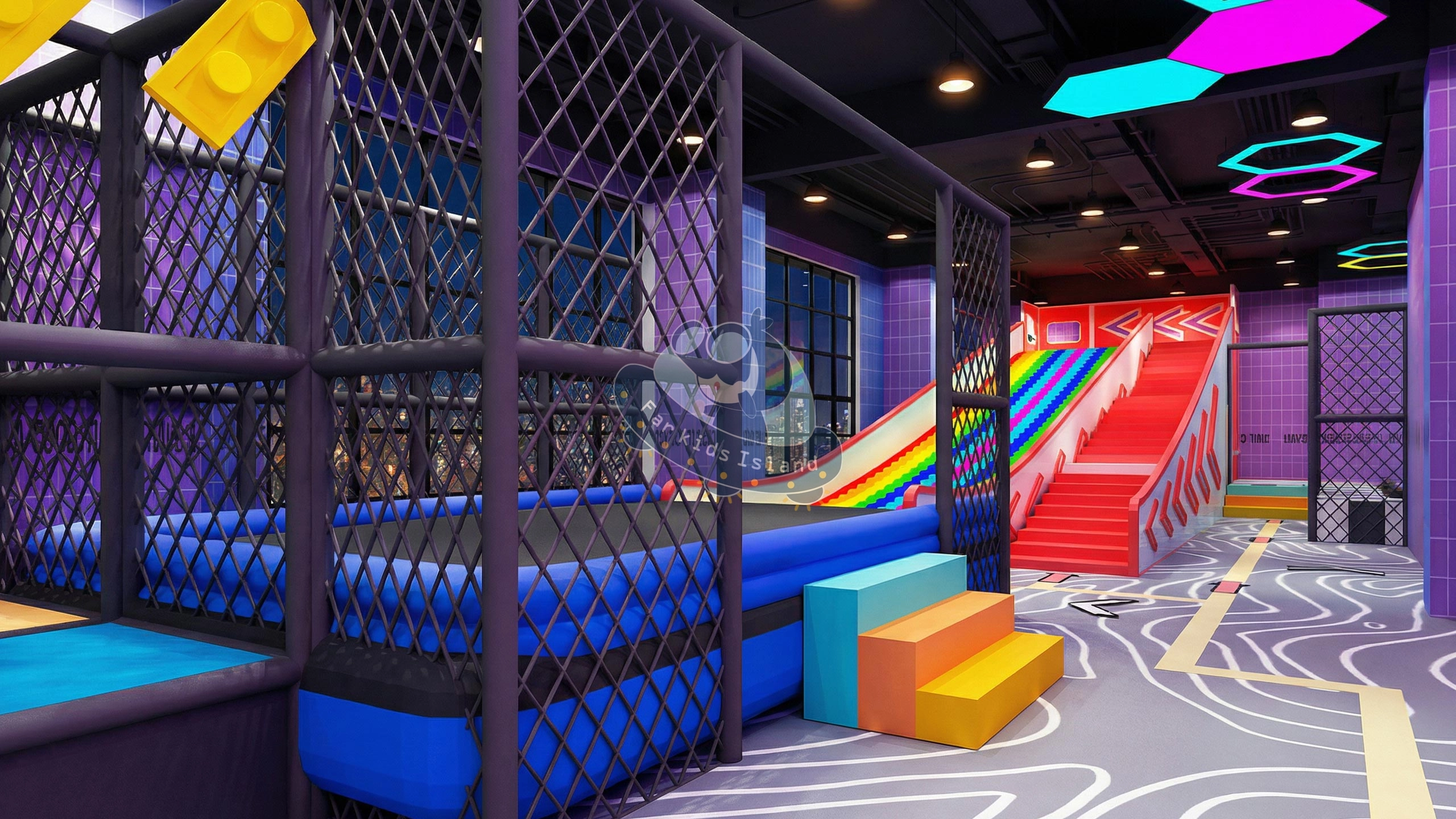
Far Kids Island — Future Sports Cyber World Indoor Playground (Malaysia)
Top Project Picks for Your Next Success




Have Questions or Need More Information?
Ready to Dive Deeper into This Topic?
Explore Detailed Insights and Start Applying Knowledge to Your Project
We’re here to help! Fill out the form below to reach out to our team. Whether you have a question about the article or need assistance with your project, we’re happy to assist you.
Trusted Playground Solution Provider
Professional one-stop indoor playground solutions with a strong focus on design, safety, and eco-friendly materials.
Our Location
No. 106, No. 27, Jiejin 2nd Road, Shiqiao Street, Panyu District, Guangzhou, China.
Say Hello
Social Links
Whatsapp: +8613632109166
Far kids island
Far kids island
Far kids island
TONGSHUO
Guo Wenshu