





Indoor Playground Equipment Cost Comparison: Modular Play Structures vs. Custom-Designed Solutions
- How Modular and Bespoke Play Systems Differ Financially
- Modular structures support predictable budgeting
- Custom solutions increase design and engineering expenditure
- Purchase price is only one part of the investment
- Key Variables That Change the Total Project Budget
- Venue size, height, and circulation requirements
- Materials, safety surfacing, and durability
- Freight, installation, and after-sales support
- Choosing the Right Commercial Model for the Venue
- When modular equipment is the stronger option
- When a custom solution can produce stronger returns
- A hybrid strategy can balance capital control and differentiation
- Supplier Evaluation and Commercial Due Diligence
- Review technical documentation before comparing quotations
- Assess manufacturing capability and lifecycle service
- Focus on operational value after opening
- Frequently Asked Questions
Indoor playground equipment cost depends on far more than the purchase price of slides, climbing frames, ball pits, or soft-play components. The final investment is shaped by venue size, ceiling height, floor plan, theme complexity, safety surfacing, engineering, freight, installation, inspection, maintenance access, and the revenue capacity of the finished attraction. Modular play structures generally provide faster planning, standardized components, predictable manufacturing, and lower design expense, while custom-designed solutions require a larger upfront commitment but can improve space utilization, brand differentiation, visitor flow, and long-term commercial value. Buyers should compare total cost of ownership and expected return on invested capital rather than selecting a system solely on the lowest quotation.
How Modular and Bespoke Play Systems Differ Financially
Modular structures support predictable budgeting
Modular indoor play systems are assembled from pre-engineered components such as platforms, crawl tunnels, ramps, slides, bridges, climbing panels, sensory elements, and protective barriers. Because many parts are already designed for repeat production, manufacturers can often provide clearer bills of materials, shorter engineering cycles, and more stable production schedules. This structure makes modular equipment suitable for operators working within a fixed opening date or a defined procurement budget.
The principal financial advantage is cost predictability. Standardized parts reduce one-time design charges, tooling requirements, prototype development, and engineering revisions. Replacement planning is also simpler because operators can identify common component types and maintain an inventory of frequently used fittings, fasteners, padding, nets, and wear surfaces. However, a modular system may leave unused corners, create less distinctive customer experiences, or require compromises when the building has irregular columns, low clearances, mezzanines, or unusual access routes.
Custom solutions increase design and engineering expenditure
A custom-designed play environment is developed around a specific site, target age range, operating model, theme, and customer journey. The process may include architectural coordination, three-dimensional modeling, structural calculations, color and material development, circulation planning, accessibility review, branded theming, prototype production, and multiple approval stages. These activities create additional professional and manufacturing costs before installation begins.
That additional expenditure can be commercially justified when the project depends on a memorable destination experience. A distinctive pirate ship, rainforest, space station, local cultural theme, or integrated trampoline and soft-play zone can support High Quality admission, birthday-party sales, food and beverage purchases, memberships, and social-media visibility. Customization is most valuable when it improves the use of difficult space or creates a clear reason for families to choose one venue over a nearby competitor.
Purchase price is only one part of the investment
Buyers should separate equipment price from the complete installed project budget. A credible comparison includes concept design, site measurement, shop drawings, structural review, safety surfacing, electrical work, HVAC adjustments, lighting, fire-protection coordination, shipping, import duties, unloading, assembly, staff training, inspection, signage, cleaning tools, spare parts, and commissioning. Some quotations include installation and freight; others exclude them, making apparently inexpensive proposals difficult to compare.
| Cost category | Modular play structure | Custom-designed play environment | Procurement implication |
|---|---|---|---|
| Concept and engineering | Usually lower because components are pre-engineered | Usually higher because the design is site-specific | Request a clearly itemized design and engineering scope |
| Manufacturing lead time | Often more predictable when standard parts are available | May be longer because of prototypes, approvals, and special fabrication | Align design freeze with the construction schedule |
| Space utilization | Good in regular floor plans | Can be optimized around columns, levels, and unusual geometry | Measure revenue-producing area, not only equipment footprint |
| Brand differentiation | Moderate unless enhanced with graphics and theming | High when the concept is developed around the venue identity | Assess whether differentiation supports pricing and repeat visits |
| Replacement and maintenance | Generally simpler when parts are standardized | May require project-specific parts or fabrication | Confirm spare-part availability and lifecycle support |
| Expansion potential | Often straightforward through compatible modules | Possible, but future additions may require design coordination | Reserve structural and circulation capacity for growth |
Key Variables That Change the Total Project Budget
Venue size, height, and circulation requirements
Square footage alone does not determine the value or feasibility of a play installation. Clear ceiling height affects the number of levels, slide configuration, overhead clearance, and fall-zone planning. Columns, emergency exits, sprinkler heads, air ducts, lighting fixtures, doors, and structural beams can reduce usable space. A professional site survey should document dimensions, obstructions, floor loading, access routes, power availability, and fire-safety constraints before the layout is priced.
Efficient circulation is also a financial issue. A system that fills every available area may appear to maximize capacity but can create congestion, supervision problems, and slower evacuation. Operators should evaluate the relationship between active play zones, toddler areas, seating, party rooms, reception, shoe storage, restrooms, and staff sightlines. A slightly smaller installation may generate better returns if it improves throughput and allows employees to supervise more effectively.
Materials, safety surfacing, and durability
Material specifications influence both acquisition price and operating performance. Powder-coated steel, molded plastic, high-density foam, fire-retardant upholstery, commercial-grade netting, laminated panels, and impact-absorbing flooring each have different durability and cleaning characteristics. Cheap materials may reduce the initial quotation while increasing color fading, tearing, odor retention, downtime, or replacement frequency.
Safety should be treated as a design requirement rather than an optional upgrade. Buyers should request information about fall protection, entrapment prevention, edge treatment, load capacity, flame performance, sanitation, and inspection procedures. Relevant guidance may include ISO 12100 principles for machinery safety and risk reduction, applicable local building and fire codes, and recognized playground guidance such as the U.S. Consumer Product Safety Commission Public Playground Safety Handbook. Indoor commercial attractions may also fall under specialized national or regional standards, so the applicable jurisdiction must be confirmed before production.
Freight, installation, and after-sales support
International freight can be affected by package volume, container utilization, port charges, customs classification, insurance, inland delivery, and local handling equipment. Large custom panels and themed structures may consume more container space than modular components, even when their raw material weight is similar. Buyers should request Incoterms, packing lists, estimated shipment dimensions, delivery responsibilities, and installation exclusions in writing.
Installation quality has a direct effect on safety, appearance, and future maintenance. A supplier should provide assembly drawings, anchoring details, torque requirements, inspection checklists, and commissioning documentation. The contract should also define warranty duration, response times, exclusions, replacement-part pricing, remote support, and the process for modifying the structure after handover. The ISO 9001 quality management framework is not a product certification by itself, but a certified quality system can indicate that a manufacturer has formal processes for documentation, corrective action, and continuous improvement.
Choosing the Right Commercial Model for the Venue
When modular equipment is the stronger option
Modular equipment is often appropriate for first-time operators, school and childcare projects, temporary attractions, smaller family entertainment centers, and venues with a regular rectangular layout. It can reduce concept risk, simplify procurement, and enable phased development. A modular approach is also practical when the business model depends on reliable throughput rather than a highly themed destination experience.
Operators should still customize the configuration around age segmentation, capacity, supervision, and local preferences. Standard does not have to mean generic. Color palettes, graphics, signage, interactive panels, soft obstacles, toddler features, and branded entry elements can create a recognizable environment without the engineering expense of a completely bespoke structure.
When a custom solution can produce stronger returns
Custom design becomes more compelling when the site has unusual architecture, High Quality positioning, limited competition, strong brand requirements, or multiple revenue zones. Resorts, flagship malls, museums, destination entertainment centers, and franchise concepts may benefit from a cohesive environment that connects the play attraction with the broader customer experience.
The investment case should be tested with measurable assumptions. Project owners can estimate required attendance, average ticket price, party-booking revenue, membership conversion, ancillary spending, operating hours, staffing costs, maintenance downtime, and payback period. Customization should be approved when it contributes to measurable commercial outcomes, not merely because it looks impressive in a rendering.
A hybrid strategy can balance capital control and differentiation
Many successful projects combine a standardized structural core with custom visual and interactive elements. For example, a modular multi-level frame can be adapted with branded panels, signature slides, themed portals, interactive games, a dedicated toddler zone, or a connected trampoline park area. This approach preserves manufacturing efficiency while allowing the venue to express its identity.
A hybrid plan can also support future expansion. The initial phase may prioritize the highest-demand play functions, while foundations, circulation routes, electrical provisions, and staff zones are planned for later additions. Such phased planning protects cash flow and reduces the risk of purchasing a large attraction before local demand has been validated.
Supplier Evaluation and Commercial Due Diligence
Review technical documentation before comparing quotations
Competitive procurement should begin with a common technical brief. The brief should define the available area, ceiling height, intended users, capacity target, operating hours, design theme, required features, local codes, installation conditions, delivery date, warranty expectations, and documentation requirements. Without a consistent brief, suppliers may quote different product scopes that cannot be compared fairly.
Buyers should request general arrangement drawings, rendered views, material specifications, risk-assessment documentation, inspection procedures, maintenance schedules, load information, and a detailed commercial breakdown. The supplier should identify what is included, excluded, optional, or dependent on site conditions. Independent review by a local architect, engineer, fire consultant, or safety professional is advisable for complex venues.
Assess manufacturing capability and lifecycle service
Manufacturing capacity matters because a supplier may be able to produce a visually attractive design but lack the systems required for consistent quality at commercial scale. Buyers should evaluate welding and fabrication controls, surface finishing, foam and upholstery processes, packaging, quality inspections, traceability, and pre-shipment verification. Factory photographs and certificates are useful, but direct evidence such as inspection records, sample approvals, and reference projects provides stronger assurance.
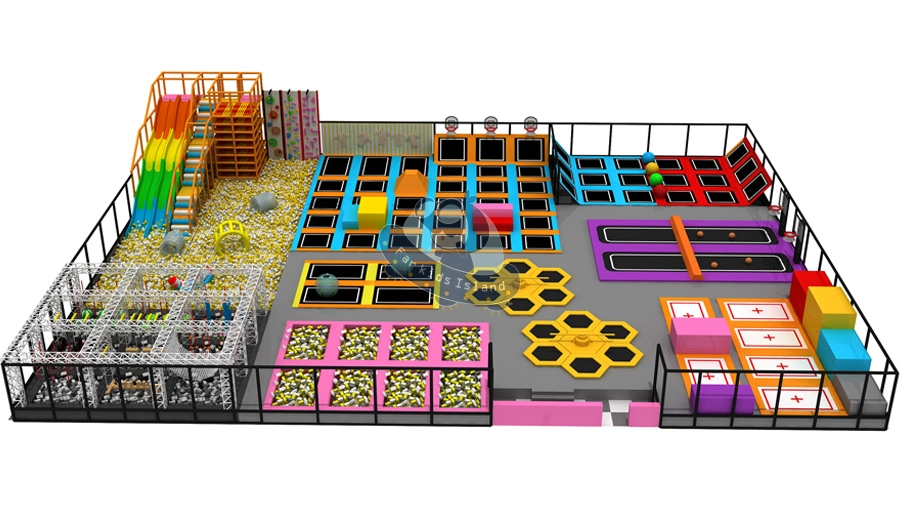
Our team approaches indoor play projects as integrated commercial environments rather than isolated product purchases. We coordinate design development, component selection, production planning, quality control, packing, delivery support, and installation guidance so that project owners can manage the full procurement cycle with fewer handover gaps. Our product scope includes indoor playground equipment and trampoline park equipment, allowing operators to combine soft play, climbing, jumping, obstacle, and interactive activity zones within one coordinated concept.
Focus on operational value after opening
Our engineering and manufacturing process is structured around practical operating requirements: safe circulation, age-appropriate zoning, accessible maintenance points, durable materials, clear supervision, and efficient use of available floor area. For larger projects, our team can support layout refinement and feature integration so that the final attraction aligns with the venue’s capacity, theme, and commercial objectives.
Supplier value should continue after installation. A responsible partner helps operators understand cleaning routines, inspection intervals, replacement procedures, staff training, and safe-use rules. Maintenance documentation should be understandable to local teams, and commonly replaced components should remain available for the expected service life. These factors influence uptime, customer confidence, and the long-term economics of the attraction more than a small difference between competing initial quotations.
Before approving a purchase, buyers should create a weighted scorecard covering total installed investment, compliance documentation, delivery certainty, design quality, material durability, service responsiveness, spare-parts access, warranty terms, and expected revenue contribution. This method prevents a low bid from winning when it carries substantial technical or operational risk.
Contact our team to review your venue requirements and explore indoor playground equipment or trampoline park equipment solutions suited to your layout, budget, and growth plan.
Frequently Asked Questions
What factors determine the total investment for an indoor playground project?
The total investment includes equipment, concept design, site measurement, engineering, safety surfacing, freight, installation, import duties, electrical and HVAC adjustments, inspection, staff training, signage, spare parts, and commissioning.
Are modular indoor play structures less expensive than custom-designed solutions?
Modular systems are generally more predictable and often have lower design and engineering expenses because they use pre-engineered components. Custom solutions usually cost more upfront because they require site-specific design, themed fabrication, prototypes, and additional approvals.
When is custom playground design commercially justified?
Custom design can be justified when a venue has unusual architecture, premium positioning, strong branding requirements, limited competition, or a business model that depends on destination appeal, repeat visits, memberships, party bookings, and ancillary spending.
What should buyers request from an indoor playground supplier?
Buyers should request general arrangement drawings, rendered views, material specifications, risk-assessment documentation, inspection procedures, maintenance schedules, load information, warranty terms, delivery details, and a detailed breakdown of included and excluded items.
How can operators compare supplier quotations fairly?
Operators should issue a common technical brief and compare total installed investment, compliance documentation, delivery certainty, design quality, durability, service responsiveness, spare-parts access, warranty terms, and expected revenue contribution rather than comparing equipment price alone.
Can modular and custom playground features be combined?
Yes. A hybrid strategy can use a standardized structural core with custom visual, branded, interactive, toddler, slide, or trampoline elements, balancing manufacturing efficiency with venue differentiation and future expansion potential.
ROI: Profitability of Commercial Indoor Playgrounds
Comparing Foam versus Plastic Components in Commercial Soft Play
2026 Trends in commercial trampoline park equipment Purchasing
Indoor Amusement Park Equipment Manufacturer Pricing: Cost Breakdown, Budget Factors, and Total Investment Guide
Top Project Picks for Your Next Success



Have Questions or Need More Information?
Ready to Dive Deeper into This Topic?
Explore Detailed Insights and Start Applying Knowledge to Your Project
We’re here to help! Fill out the form below to reach out to our team. Whether you have a question about the article or need assistance with your project, we’re happy to assist you.
Trusted Playground Solution Provider
Professional one-stop indoor playground solutions with a strong focus on design, safety, and eco-friendly materials.
Our Location
No. 106, No. 27, Jiejin 2nd Road, Shiqiao Street, Panyu District, Guangzhou, China.
Say Hello
Social Links
Whatsapp: +8613632109166
Far kids island
Far kids island
Far kids island
TONGSHUO
Guo Wenshu