





What Is Included in Indoor Playground Equipment Cost? A Breakdown of Equipment, Installation, Shipping, and Site Preparation
- How Commercial Play Space Budgets Are Structured
- Core play equipment and activity modules
- Design, engineering, and customization
- Safety surfacing and ancillary items
- Installation, Logistics, and Site Preparation Expenses
- Factory packing, shipping, and import charges
- Professional installation and commissioning
- Building preparation and utility coordination
- How Buyers Can Control Total Project Investment
- Use a landed-cost and lifecycle-cost worksheet
- Compare suppliers on compliance and documentation
- Evaluate commercial return, not only purchase price
- Why Far Kids Island Is a Turnkey Manufacturing Partner
- Integrated design and manufacturing capability
- Commercial product solutions for different venues
- Safety-focused materials and project support
- Frequently Asked Questions
Indoor playground equipment cost is best understood as a complete project investment rather than a single product price. The final budget normally combines the play system, soft-play components, trampoline or climbing features, safety flooring, custom design, engineering documents, packing, shipping, duties, installation, site preparation, inspections, and operational support. For buyers, the most reliable comparison is a total landed and operational cost model that connects every line item to the venue size, age range, capacity, safety requirements, local building conditions, and expected revenue. A low factory quotation may become expensive if it excludes freight, installation, structural reinforcement, or replacement parts.
How Commercial Play Space Budgets Are Structured
Core play equipment and activity modules
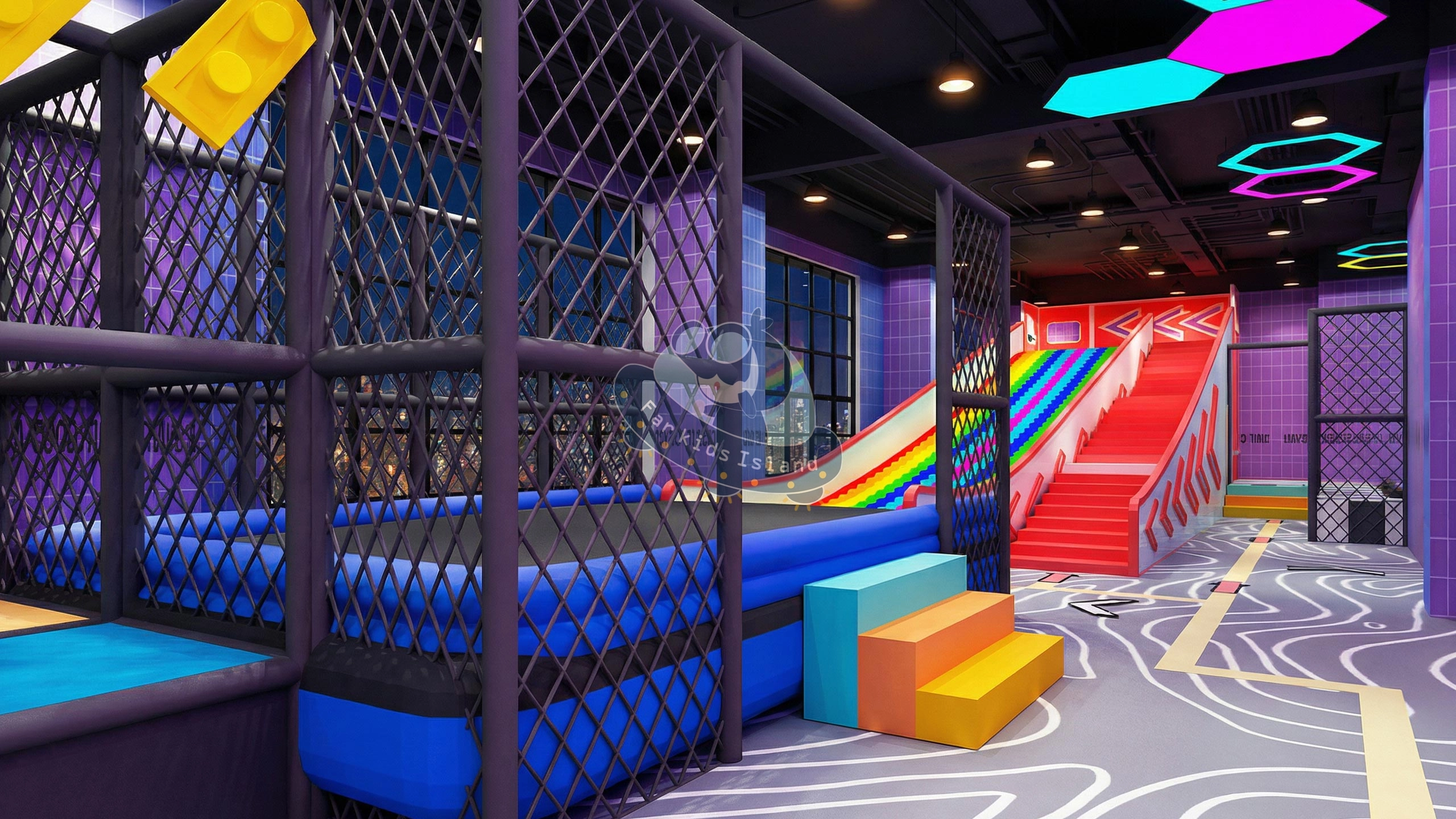
The equipment package is usually the largest visible portion of a quotation. It may include multi-level soft-play towers, slides, tunnels, bridges, ball pools, climbing walls, obstacle elements, interactive panels, role-play zones, toddler structures, seating, lockers, and staff access gates. A project using trampoline park equipment may also require interconnected trampolines, foam pits, airbags, dodgeball courts, basketball dunk lanes, climbing features, and protective padding. Each module affects the price through dimensions, materials, fabrication complexity, load capacity, customization, and required clearance.
Commercial buyers should request a detailed bill of materials instead of accepting a quotation described only as one complete playground set. The bill should identify the number and type of platforms, slides, posts, nets, padding panels, fasteners, floor systems, signage, and accessories. It should also state whether the quoted capacity refers to simultaneous users, the recommended age groups, and the assumed operating hours. These details help operators calculate throughput, staffing needs, and potential maintenance exposure.
Design, engineering, and customization
Custom theming can materially change the budget. A standard modular layout generally costs less than a branded environment with sculpted façades, architectural scenery, custom colors, illuminated features, printed graphics, or interactive technology. Design fees may cover site measurements, 2D floor plans, 3D visualization, circulation planning, evacuation routes, ceiling-clearance checks, and revisions. Engineering documentation may be priced separately when the project requires structural calculations, anchoring plans, fire coordination, or local authority submissions.
Good design is not decoration added after procurement. It determines whether children and caregivers can move safely, whether staff can see blind spots, whether emergency exits remain accessible, and whether revenue-generating zones use the available floor area efficiently. A buyer should confirm the number of design revisions, the file formats supplied, ownership of drawings, and whether the supplier will adapt the layout after a site survey.
Safety surfacing and ancillary items
Protective flooring is often overlooked because it sits below the main structure. Depending on the activity, the specification may include EVA tiles, impact-absorbing mats, rubber flooring, padded wall protection, trampoline edge cushions, foam pit blocks, or specialized landing surfaces. The correct system depends on fall height, user behavior, cleaning procedures, moisture exposure, and the applicable standard or authority requirement.
Ancillary costs can include reception counters, shoe storage, benches, tables, birthday-room furniture, queue barriers, cleaning equipment, first-aid cabinets, warning signs, access-control equipment, and replacement padding. These items may not be part of the headline package, but they influence opening readiness and daily operating efficiency. Buyers should separate essential safety and operating items from optional décor so that value-engineering decisions do not compromise risk control.
Installation, Logistics, and Site Preparation Expenses
Factory packing, shipping, and import charges
International logistics begins before the cargo leaves the factory. Equipment must be labeled, grouped by installation sequence, protected against abrasion, and packed in a way that controls volume and damage risk. The shipping method may be based on full-container load, less-than-container load, air freight for urgent parts, or a combination of methods. Freight cost depends on dimensional volume, gross weight, origin, destination, season, port conditions, fuel charges, and the selected Incoterm.
A quotation should clearly state whether it is EXW, FOB, CIF, DAP, or another delivery basis. The buyer should also verify who pays export documentation, marine insurance, destination terminal handling, customs brokerage, import duty, value-added tax, port storage, last-mile delivery, and unloading equipment. A container arriving at a venue does not automatically mean the materials have been delivered to the installation area. Restricted loading access, stairs, narrow doors, and long internal transport routes can add labor and equipment charges.
Professional installation and commissioning
Installation pricing may include supervisor travel, local labor, assembly, anchoring, protective padding, net tensioning, leveling, cleaning, safety labeling, and final handover. Complex venues may require lifts, scaffolding, forklifts, lifting teams, or night work to avoid disrupting a shopping mall or operating facility. Trampoline installations require particularly careful alignment, frame connection, padding placement, and inspection of transition areas.
Buyers should ask whether installation is fixed-price or charged by time and materials. The contract should define the number of installers, expected duration, access requirements, accommodation responsibility, commissioning tests, punch-list correction, and warranty start date. A remote technical guide may reduce the initial price, but professional installation is generally more appropriate for large commercial structures, multi-level systems, and projects subject to local inspection.
Building preparation and utility coordination
Site preparation can include demolition, floor leveling, waterproofing, painting, electrical circuits, lighting, ventilation, air conditioning, plumbing, fire alarm interfaces, emergency lighting, doors, ceiling protection, and accessibility improvements. Existing warehouses and retail units may need structural surveys before equipment is ordered. A suspended ceiling, sprinkler network, column grid, or low beam can restrict the usable height and force changes to the layout.
Structural reinforcement is a separate concern when equipment must be fixed to a slab, wall, or overhead support. The supplier can provide anchoring loads and installation drawings, but the local building engineer normally confirms the suitability of the structure. Fire exits and travel paths should be coordinated with the property owner and relevant authority. The ISO 8124 toy safety standards provide an international reference for toy-related safety, while commercial playground projects may also require regional building, fire, accessibility, and amusement-facility rules.
| Budget category | Typical scope | Primary cost drivers | Quotation question |
|---|---|---|---|
| Equipment package | Play structures, slides, nets, padding, activity modules | Size, capacity, materials, complexity, customization | Is a complete bill of materials included? |
| Design and engineering | Site plan, 3D design, technical drawings, revisions | Theme detail, approval requirements, structural review | How many revisions and engineering documents are supplied? |
| Safety systems | Impact flooring, wall padding, labels, access controls | Fall height, area coverage, local requirements | Which safety surfaces and certificates are included? |
| Logistics | Packing, export handling, ocean freight, destination delivery | Volume, route, Incoterm, port fees, customs | Which charges are excluded after the factory gate? |
| Installation | Assembly, anchoring, testing, handover | Complexity, access, labor rates, travel, equipment rental | Is commissioning covered by a fixed price? |
| Site preparation | Floor, utilities, lighting, ventilation, fire coordination | Existing building condition and landlord requirements | Who completes and approves building modifications? |
How Buyers Can Control Total Project Investment
Use a landed-cost and lifecycle-cost worksheet
A procurement worksheet should distinguish the factory price from the delivered and operational investment. At minimum, model equipment, design, packaging, inland transport, international freight, insurance, customs, taxes, unloading, installation, site work, permits, staff training, spare parts, cleaning supplies, and contingency. The contingency should reflect project uncertainty rather than being used to hide unclear quotations. Renovation-heavy projects may require a larger allowance than a ready-to-use commercial unit.
Lifecycle analysis is equally important. Materials with better abrasion resistance, replaceable padding, accessible fasteners, washable surfaces, and available spare parts can reduce downtime even when their initial price is higher. Ask for warranty exclusions, expected maintenance intervals, color-matching policies, lead times for replacement components, and the procedure for reporting a defect. A supplier that documents preventive maintenance helps protect revenue and customer trust.
Compare suppliers on compliance and documentation
Price comparisons should include technical evidence. Buyers can request material specifications, test reports, quality-control records, installation manuals, cleaning instructions, load information, and certificates relevant to the destination market. ASTM F1918 addresses safety requirements for soft contained play equipment, and the ASTM F2970 standard provides a reference for trampoline courts. These standards do not replace local law or a project-specific risk assessment, but they provide useful benchmarks for supplier discussions.
Certification claims should be checked against the actual product scope, certificate holder, test date, material, and manufacturing location. A certificate for raw material does not necessarily certify the complete installed playground. Procurement teams should also confirm quality inspection points, factory acceptance procedures, packaging photographs, and the process for resolving nonconformities before shipment.
Evaluate commercial return, not only purchase price
For a family entertainment center, the business case depends on usable capacity, admission pricing, party-room sales, food and beverage conversion, repeat visits, staff requirements, cleaning time, and downtime. A school or resort may prioritize durability, supervision, inclusive access, and educational value instead of maximum throughput. A layout that improves visibility and circulation can reduce staffing pressure and increase the number of paying users safely accommodated.
Buyers should build several scenarios: conservative attendance, expected attendance, seasonal peak, and temporary closure for maintenance. The resulting model can compare payback period, utilization, maintenance reserve, and replacement-cycle assumptions. This approach prevents a visually impressive design from being approved without understanding its operating economics.
Why Far Kids Island Is a Turnkey Manufacturing Partner
Integrated design and manufacturing capability
Far Kids Island is the global brand of Guangdong Tongshuo Industrial Co., Ltd., a commercial indoor and outdoor playground manufacturer based in Guangzhou, China. Established in 2012 with manufacturing roots dating back to 1993, our organization brings more than 30 years of industry expertise to project development. Our 20,000㎡ manufacturing facility is supported by more than 200 professionals and over 20 senior design experts.
We integrate research and development, custom 3D design, in-house production, and global sales rather than treating design, manufacturing, and installation as disconnected services. This model allows our team to coordinate theme development, space planning, equipment fabrication, material selection, packaging, and project documentation from one accountable source. For investors and distributors, that coordination can reduce communication gaps and make the quotation easier to audit.
Commercial product solutions for different venues
Our portfolio includes commercial indoor playground equipment for family entertainment centers, schools, shopping malls, resorts, and mixed-use venues. We also develop trampoline park equipment, including activity combinations designed around circulation, impact protection, supervision, and efficient use of ceiling height. Solutions can be adapted for toddlers, school-age children, teenagers, family groups, or mixed-age operations.
Theme customization may include color systems, branded graphics, sculpted scenery, role-play environments, climbing challenges, interactive components, and complementary furniture. The objective is to create a recognizable guest experience while retaining practical access for cleaning, inspection, repair, and staff supervision. Our engineering and design process considers the available footprint, column positions, ceiling height, entry and exit routes, target capacity, and operating model before production begins.
Safety-focused materials and project support
Our philosophy is Designed for Children, Built for Safety. We use non-toxic, commercial-grade, sustainable materials and provide ASTM and COC certification support for applicable products and projects. Documentation should always be reviewed against the destination market and the exact installed configuration, but material traceability and quality-control records give buyers a stronger basis for approval.
Far Kids Island provides a turnkey experience that can cover space planning, theme development, manufacturing, professional installation, commissioning, and operational training. Our solutions have been exported to clients in more than 30 countries. Training can address daily inspection, cleaning, guest rules, staff positioning, incident response, and basic maintenance. These services help project owners move from shipment receipt to safe commercial operation with fewer avoidable delays. Additional company information and product details are available at Far Kids Island.
For a reliable procurement decision, buyers should request a site-specific proposal that separates equipment, design, logistics, installation, site preparation, certification, training, warranty, and spare parts. Contact Far Kids Island at sulla.tongshuo@gmail.com to review a custom indoor playground or trampoline park project, validate the total investment, and develop a practical route from concept to opening.
Frequently Asked Questions
What is included in indoor playground equipment cost?
The total project investment can include play structures, safety surfacing, custom design, engineering documents, packaging, shipping, customs, installation, site preparation, inspections, training, spare parts, and operational support.
Does a supplier quotation usually include shipping and installation?
Not always. Buyers should verify the Incoterm and confirm whether export handling, international freight, destination charges, customs, unloading, travel, local labor, equipment rental, assembly, and commissioning are included.
Why can custom playground design increase the project budget?
Custom themes may require additional 3D design, sculpted scenery, branded graphics, special colors, interactive features, engineering revisions, and more complex fabrication than a standard modular layout.
What site preparation is required before installation?
Potential requirements include floor leveling, waterproofing, electrical work, lighting, ventilation, fire-alarm coordination, emergency lighting, access improvements, demolition, and structural review for anchoring loads.
How should buyers compare playground manufacturers?
Compare the complete bill of materials, technical documentation, relevant certificates, material specifications, warranty terms, spare-parts support, installation scope, project references, quality controls, and total landed and lifecycle cost rather than factory price alone.
Does Far Kids Island provide turnkey playground services?
Yes. Far Kids Island can support space planning, theme development, custom 3D design, in-house manufacturing, professional installation, commissioning, operational training, and global project delivery for indoor playgrounds and trampoline parks.
Commercial Indoor Playground Project Examples: Design Choices & Buyer Lessons
Compare Commercial Indoor Playground Equipment Manufacturers by QC
How to Calculate the ROI and Total Cost of Ownership of Indoor Playground Equipment
Lighting and Acoustics in Custom Indoor Playground Design
Top Project Picks for Your Next Success


Have Questions or Need More Information?
Ready to Dive Deeper into This Topic?
Explore Detailed Insights and Start Applying Knowledge to Your Project
We’re here to help! Fill out the form below to reach out to our team. Whether you have a question about the article or need assistance with your project, we’re happy to assist you.
Trusted Playground Solution Provider
Professional one-stop indoor playground solutions with a strong focus on design, safety, and eco-friendly materials.
Our Location
No. 106, No. 27, Jiejin 2nd Road, Shiqiao Street, Panyu District, Guangzhou, China.
Say Hello
Social Links
Whatsapp: +8613632109166
Far kids island
Far kids island
Far kids island
TONGSHUO
Guo Wenshu