





Indoor Playground Equipment Cost: A Complete B2B Buyer’s Guide to Pricing and Investment Planning
- How Commercial Play-Space Pricing Is Built
- Equipment category, capacity, and activity mix
- Space planning, architecture, and customization
- Materials, safety engineering, and compliance
- Budget Components Buyers Should Include
- Direct procurement and project delivery costs
- Construction, fit-out, and operational infrastructure
- Lifecycle reserves and cost-control planning
- How to Compare Quotations and Forecast Return
- Use a normalized quotation rather than the lowest headline number
- Connect capital expenditure with revenue assumptions
- Control change orders and procurement risk
- Why Far Kids Island Supports a Lower-Risk Investment Plan
- Integrated design and manufacturing capability
- Turnkey solutions for different commercial models
- Safety, materials, and international project experience
- Recommended buyer process for a reliable result
- Frequently Asked Questions
Commercial indoor play-space pricing is determined by far more than the purchase price of slides, climbing structures, soft play modules, or trampoline park equipment. A reliable investment plan must account for usable floor area, ceiling height, age segmentation, theme development, structural engineering, safety surfacing, fire and electrical requirements, freight, installation, staff training, maintenance, insurance, and the expected revenue model. For family entertainment centers, shopping malls, resorts, schools, and franchise operators, the most accurate approach is to evaluate total project cost and lifecycle return together. This guide explains the major cost drivers, procurement benchmarks, quotation-comparison methods, and investment controls required to make a commercially sound decision.
How Commercial Play-Space Pricing Is Built
Equipment category, capacity, and activity mix
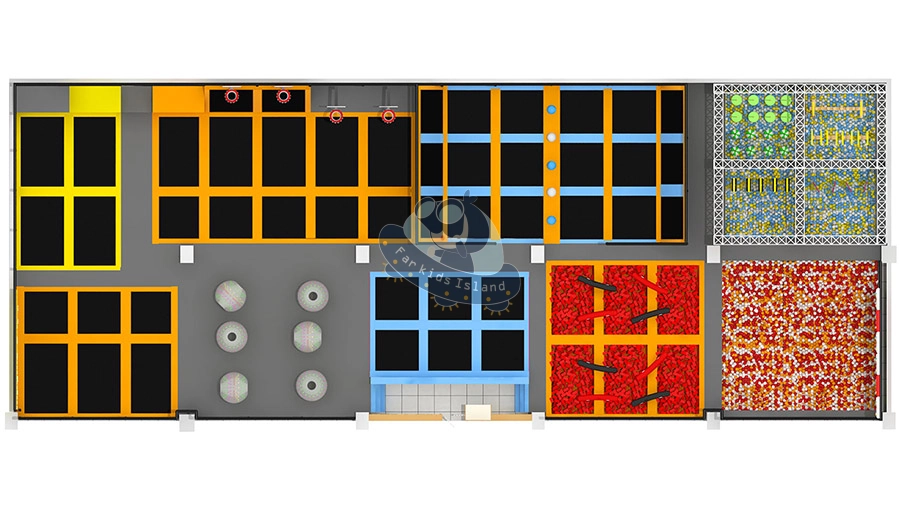
The first pricing variable is the type and quantity of attractions included in the project. A basic soft play area may contain padded climbing elements, tunnels, slides, ball pools, interactive panels, and toddler equipment. A larger family entertainment center may add multi-level play frames, ninja courses, role-play zones, sports courts, party rooms, interactive projection, and redemption games. Trampoline parks require a different engineering and operational model because the package can include interconnected trampolines, angled walls, foam pits, airbags, dodgeball courts, basketball lanes, climbing features, and fall-protection systems.
Capacity is equally important. Two projects with the same floor area may have very different budgets if one is designed for toddlers and the other is designed for high-throughput users aged six to twelve. Dense layouts can increase revenue potential, but they also require careful circulation planning, visibility, evacuation access, queue control, and supervision zones. Buyers should request a capacity plan showing the intended number of users by age group, attraction, and operating period rather than selecting equipment solely by visual appeal.
Space planning, architecture, and customization
Custom design affects the budget through concept development, 2D and 3D drawings, structural calculations, branding, color palettes, themed facades, signage, lighting, and integration with the building. A standard catalog package is generally faster to quote and manufacture, while a custom pirate, jungle, ocean, space, cartoon, or local-culture theme requires additional design coordination and fabrication.
Building conditions can create substantial cost variation. Existing columns, low ceilings, uneven floors, sprinkler locations, HVAC ducts, emergency exits, load-bearing limitations, and restricted delivery routes may require redesign or construction work. Before requesting final quotations, project owners should provide an accurate site survey, architectural plan, ceiling height, access information, fire strategy, and photographs. A supplier that prices equipment without reviewing these conditions may later issue variation orders.
Materials, safety engineering, and compliance
Commercial equipment must be designed for repeated public use rather than occasional residential use. Important specifications include steel tubing, weld quality, powder coating, foam density, vinyl or PVC wear layers, netting strength, fastener protection, edge treatment, impact attenuation, flame performance, and cleanability. Material upgrades may increase the initial purchase price but reduce replacement frequency, downtime, and safety-related liability.
Compliance should be evaluated at the design stage. The ASTM F1918 standard for soft contained play equipment addresses safety requirements and test methods relevant to commercial soft play environments. For amusement and attraction installations, buyers can also review the ISO 17842 series for safety of amusement rides and devices. In the United States, the U.S. Consumer Product Safety Commission Public Playground Safety Handbook provides useful guidance on surfacing, fall zones, entrapment, protective barriers, and maintenance principles, although local authorities and project-specific regulations remain decisive.
Budget Components Buyers Should Include
Direct procurement and project delivery costs
A supplier quotation should separate the equipment package from services and logistics. Direct procurement commonly includes the play structure, slides, climbing components, trampoline beds, padding, nets, interactive features, furniture, and spare parts. Project delivery may include design, engineering drawings, sampling, packaging, export documentation, inland transport, ocean or air freight, destination charges, customs duties, local taxes, unloading, installation, commissioning, and staff training.
Incoterms have a major effect on apparent pricing. An EXW or FOB quotation may look lower because it excludes certain transport responsibilities, while a DDP quotation may include more of the landed cost but still require confirmation of local permits and site work. Buyers should ask for a line-by-line landed-cost model and clarify who is responsible for port handling, import clearance, unloading equipment, storage, local delivery, and disposal of packaging materials.
Construction, fit-out, and operational infrastructure
Equipment is only one portion of the investment. The venue may require flooring, impact-absorbing surfaces, wall protection, reception counters, lockers, seating, party rooms, toilets, changing areas, lighting, ventilation, sound control, CCTV, access control, point-of-sale systems, Wi-Fi, fire alarm modifications, and electrical work. Trampoline facilities may require additional structural support, specialized padding, access platforms, staff stations, and rules signage.
Project owners should create separate allowances for building modifications and general fit-out. This prevents an attractive equipment quote from consuming funds needed for essential opening requirements. A practical budget should also include professional fees, permits, inspections, insurance, launch marketing, staff recruitment, uniforms, cleaning tools, and initial consumables. If these categories are omitted, the opening date and working-capital position can be compromised.
Lifecycle reserves and cost-control planning
Commercial play environments experience continuous abrasion, contamination, and mechanical stress. High-contact surfaces need cleaning and inspection; nets, padding, fasteners, springs, jump mats, and soft components may require scheduled replacement. A responsible financial model establishes a maintenance reserve from the first day of operation rather than treating repairs as unexpected events.
Buyers should request a recommended spare-parts list, warranty terms, inspection schedule, cleaning instructions, replacement lead times, and exclusions. Warranty coverage should distinguish manufacturing defects from misuse, unauthorized modification, improper cleaning, normal wear, and building movement. A lower initial price can become expensive if replacement components are proprietary, unavailable, or difficult to install locally.
| Budget area | What it includes | Quotation question | Commercial impact |
|---|---|---|---|
| Equipment package | Play frames, slides, trampolines, nets, padding, interactive features | What is included by model, quantity, material, and specification? | Determines attraction capacity, durability, and customer appeal |
| Design and engineering | Space planning, 3D visualization, technical drawings, structural coordination | Are revisions, engineering calculations, and approval drawings included? | Reduces rework, site conflicts, and delayed production |
| Logistics and installation | Packaging, freight, customs, unloading, assembly, commissioning | Which Incoterm applies and who pays destination charges? | Defines the true landed investment |
| Building fit-out | Flooring, lighting, HVAC, electrical, fire systems, reception, toilets | Has the supplier reviewed the building and local code requirements? | Protects opening schedule and compliance readiness |
| Operations reserve | Training, cleaning, inspections, spare parts, repairs, insurance | What recurring costs and replacement cycles should be modeled? | Supports uptime, safety, and long-term profitability |
How to Compare Quotations and Forecast Return
Use a normalized quotation rather than the lowest headline number
Procurement teams should compare suppliers using the same scope document. The document should state floor area, ceiling height, user age groups, target capacity, attraction list, materials, color and theme requirements, safety standards, delivery location, installation expectations, warranty period, spare parts, and documentation. Each quotation can then be normalized into equipment, design, shipping, installation, taxes, fit-out, and recurring-cost categories.
Quality assurance should be verified through factory photographs, production samples, welding and coating controls, material declarations, test reports, certificates, inspection records, and references from comparable venues. Certification claims should be checked for the correct product scope, issuing body, validity, and applicable market. A certificate alone does not replace site-specific engineering, local approval, or an operating risk assessment.
Connect capital expenditure with revenue assumptions
A sound feasibility model should estimate admission revenue, memberships, birthday parties, food and beverage, retail, camps, school programs, and group bookings. It should also model seasonality, weekday utilization, peak-hour capacity, average customer spend, discounts, payment processing, payroll, rent, utilities, cleaning, marketing, maintenance, insurance, and taxes. The key question is not simply how much the equipment costs, but whether the attraction mix can generate adequate revenue at realistic utilization levels.
Useful measures include total investment per usable square meter, revenue per visitor, revenue per attraction zone, labor cost per operating hour, maintenance cost per month, and payback period. Scenario planning should include conservative, expected, and high-utilization cases. A project that only works under maximum occupancy may carry excessive financial risk, especially in markets with seasonal demand or strong local competition.
Control change orders and procurement risk
Change orders often arise from incomplete site data, unclear exclusions, late theme revisions, unavailable materials, building-code conflicts, and misunderstandings about installation. The purchase contract should define approved drawings, manufacturing milestones, inspection rights, packaging standards, delivery responsibilities, payment stages, acceptance criteria, warranty remedies, and delay procedures.
Payment schedules should be connected to verifiable milestones such as design approval, material preparation, production completion, pre-shipment inspection, delivery, and commissioning. Buyers should avoid approving production before final drawings and color schedules are signed. A documented approval process protects both the buyer and the manufacturer while reducing avoidable rework.
Why Far Kids Island Supports a Lower-Risk Investment Plan
Integrated design and manufacturing capability
Far Kids Island is the global brand of Guangdong Tongshuo Industrial Co., Ltd., a commercial indoor and outdoor playground manufacturer based in Guangzhou, China. Established in 2012 with manufacturing roots dating back to 1993, the company brings more than 30 years of industry knowledge to project planning, product development, fabrication, and delivery.
Our 20,000㎡ manufacturing facility is supported by more than 200 professionals and over 20 senior design experts. We integrate research and development, custom 3D design, in-house production, and global sales rather than treating design, manufacturing, and installation as disconnected activities. This structure helps buyers coordinate theme development, equipment density, circulation, safety zones, material selection, and production feasibility from the beginning.
Turnkey solutions for different commercial models
Our product portfolio includes commercial indoor playground equipment, soft play systems, toddler zones, multi-level structures, interactive play features, trampoline park equipment, climbing attractions, ninja elements, and outdoor playground solutions. Each package can be adapted to the venue’s floor plan, customer profile, branding, budget, and operating model.
We support schools, family entertainment centers, shopping malls, resorts, and independent investors with space planning, concept development, custom 3D visualization, manufacturing, packaging, installation, and operational training. This turnkey approach gives project owners a clearer view of total scope and helps reduce the coordination burden between separate designers, fabricators, logistics providers, and installers.
Safety, materials, and international project experience
Our guiding philosophy is “Designed for Children, Built for Safety.” We use commercial-grade, non-toxic, sustainable materials and provide ASTM and COC certification support for applicable products and markets. Buyers should still confirm the exact compliance requirements of the destination country, building authority, insurer, and venue type before production begins.
Far Kids Island has delivered playground solutions to clients in more than 30 countries. International experience supports practical coordination across packaging, export documentation, installation planning, local site conditions, and communication with overseas project teams. For buyers evaluating an investment, the benefit is not only a product catalog; it is access to a coordinated project partner capable of translating a business concept into a manufacturable, installable, and operational play environment.
Recommended buyer process for a reliable result
Project owners can begin by sharing the architectural plan, location, available area, ceiling height, preferred theme, target age range, expected capacity, budget range, and opening schedule. Our team can then develop a concept layout and 3D proposal, identify the major cost drivers, recommend an attraction mix, and clarify the assumptions behind the quotation. Subsequent stages should include technical review, material confirmation, drawing approval, production quality control, pre-shipment inspection, installation coordination, and staff training.
For responsible procurement, buyers should evaluate Far Kids Island on the complete value proposition: design capability, manufacturing control, documentation, customization, installation support, spare-parts planning, communication, and long-term service. The right supplier should help align capital expenditure with safety, customer experience, operating efficiency, and return potential rather than simply offering the lowest initial number.
Frequently Asked Questions
What factors have the greatest effect on commercial indoor playground pricing?
The main factors are equipment category, facility size, user capacity, ceiling height, customization, materials, safety engineering, shipping, installation, building fit-out, and local compliance requirements.
What should be included in a supplier quotation?
A quotation should clearly separate equipment, design and engineering, packaging, freight, customs, unloading, installation, commissioning, training, warranty coverage, spare parts, taxes, and any exclusions or site-work responsibilities.
How can buyers compare quotations from different manufacturers?
Buyers should use the same scope document for every supplier and normalize each quotation into equipment, design, logistics, installation, taxes, fit-out, and recurring operating costs before comparing the total landed investment.
Are trampoline park projects more expensive than soft play areas?
They can require different and often more specialized investment because they may include interconnected trampolines, structural padding, foam pits or airbags, access platforms, fall-protection systems, specialized inspections, and staff training; the final amount depends on scope and site conditions.
What hidden expenses should be included in the investment plan?
Common overlooked expenses include building modifications, flooring, lighting, HVAC, electrical and fire-system work, permits, insurance, freight and destination charges, unloading, cleaning equipment, staff training, launch marketing, spare parts, and maintenance reserves.
Does Far Kids Island provide turnkey playground project support?
Yes. Far Kids Island supports space planning, theme development, custom 3D design, in-house manufacturing, global delivery, professional installation, and operational training for commercial indoor and outdoor playground projects.
Turnkey Indoor Playground Solutions: What Does the Package Include?
Indoor Playground Equipment Cost Checklist: Questions to Ask Before Choosing a Manufacturer and Placing an Order
OEM ODM Options from an Adventure Park Equipment Manufacturer
Custom Indoor Playgrounds for Distributors and Retail Chains
Top Project Picks for Your Next Success


Have Questions or Need More Information?
Ready to Dive Deeper into This Topic?
Explore Detailed Insights and Start Applying Knowledge to Your Project
We’re here to help! Fill out the form below to reach out to our team. Whether you have a question about the article or need assistance with your project, we’re happy to assist you.
Trusted Playground Solution Provider
Professional one-stop indoor playground solutions with a strong focus on design, safety, and eco-friendly materials.
Our Location
No. 106, No. 27, Jiejin 2nd Road, Shiqiao Street, Panyu District, Guangzhou, China.
Say Hello
Social Links
Whatsapp: +8613632109166
Far kids island
Far kids island
Far kids island
TONGSHUO
Guo Wenshu