





Family Entertainment Center Equipment Installation, Maintenance, and After-Sales Service Guide
- Planning and Preparing a Commercial Indoor Play Venue
- Translate the business model into an equipment brief
- Complete a technical site survey
- Approve layout, finishes, and documentation before production
- Installation, Commissioning, and Handover Controls
- Control the installation sequence
- Verify safety and operational readiness
- Make handover operational, not merely administrative
- Maintenance, Safety Inspections, and Lifecycle Cost Control
- Use a tiered inspection program
- Build a preventive maintenance register
- Plan for parts, downtime, and renewal
- Choosing a Turnkey Playground Manufacturing Partner
- Evaluate engineering and production capability
- Why Far Kids Island supports end-to-end project delivery
- Product scope, compliance focus, and after-sales support
- Frequently Asked Questions
Successful family entertainment venues depend on more than attractive play structures: they require a coordinated lifecycle plan covering site assessment, equipment selection, engineering, installation, safety verification, staff training, preventive maintenance, and responsive after-sales service. Buyers evaluating indoor amusement solutions should connect design decisions with local building requirements, age segmentation, traffic flow, cleaning procedures, inspection records, spare-parts availability, and long-term revenue protection. This guide explains how project owners can reduce installation risk, improve operational uptime, and select a reliable supplier for commercial play systems, soft play areas, trampoline attractions, climbing features, and other indoor recreation assets.
Planning and Preparing a Commercial Indoor Play Venue
Translate the business model into an equipment brief
The first step is to define the operating model before requesting a quotation. A venue designed for toddlers, school-age children, teenagers, birthday parties, and mixed family visits will require different zoning, supervision points, impact protection, capacity assumptions, and revenue features. The project brief should identify the usable floor area, ceiling height, structural columns, emergency exits, fire-control equipment, restrooms, reception, café functions, party rooms, storage, and staff circulation.
Buyers should also document the expected daily attendance, peak-hour demand, session duration, ticket structure, membership model, and target return on investment. These inputs influence the balance between fixed play frames, role-play zones, interactive games, trampolines, climbing walls, slides, party facilities, and parent seating. A low-cost quotation can become expensive if it excludes flooring, installation access, lighting coordination, freight, local taxes, inspection fees, or replacement components.
Complete a technical site survey
A technical survey should verify dimensions rather than rely only on architectural drawings. Measurements should cover clear height below beams and sprinklers, floor levelness, slab condition, wall setbacks, door widths, elevator capacity, loading routes, electrical capacity, ventilation, humidity, and access for future repairs. Where elevated structures are planned, the supplier and local engineer should confirm anchoring conditions and the suitability of the building substrate.
Safety planning should follow a documented risk-assessment process. ISO 12100 provides a recognized framework for machinery risk assessment and risk reduction, while the U.S. Consumer Product Safety Commission Public Playground Safety Handbook offers useful guidance on hazards such as entrapment, falls, protrusions, protective surfacing, and maintenance. These references do not replace local codes or an authority having jurisdiction, but they help project teams create a more disciplined technical checklist.
Approve layout, finishes, and documentation before production
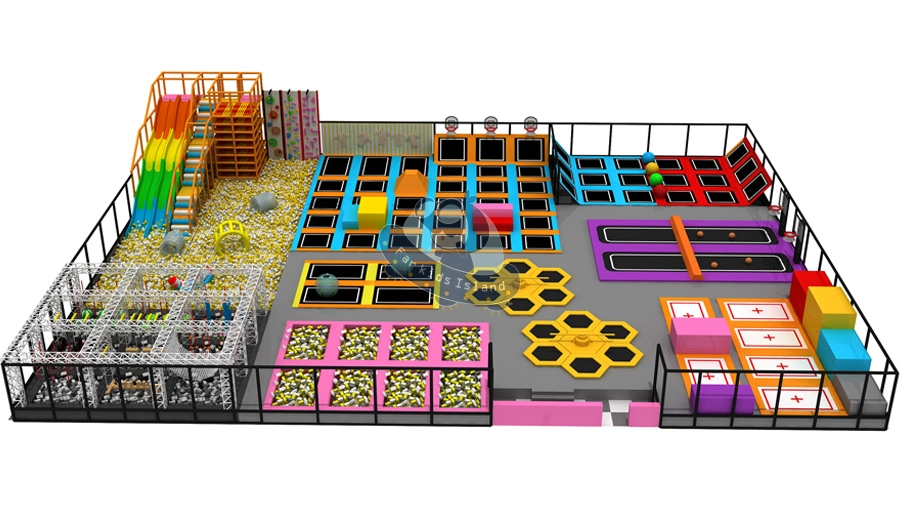
Before manufacturing begins, the owner should approve a dimensioned layout, three-dimensional renderings, equipment schedule, color and theme palette, evacuation routes, access gates, supervision sightlines, and service openings. The contract should identify the approved materials, foam densities where relevant, fabric specifications, steel treatment, fastener types, edge protection, load assumptions, warranty terms, and exclusions.
A strong documentation package includes product drawings, installation instructions, inspection forms, cleaning guidance, component lists, certificates, packing lists, and a recommended spare-parts schedule. If the venue is located outside the supplier’s home market, the buyer should confirm which documents are available in the operating country’s language and whether local engineers or inspectors require additional submissions.
Installation, Commissioning, and Handover Controls
Control the installation sequence
Installation should follow a controlled sequence rather than an informal assembly process. The site must be clean, dry, accessible, and ready for coordinated trades before equipment arrives. A typical sequence includes unloading and inventory inspection, floor marking, primary frame assembly, anchoring, platforms and access components, slides and protective elements, soft-play padding, electrical or interactive features, signage, and final cleaning.
The project manager should maintain an installation checklist with photographic evidence. Each item should be checked against the approved drawing, including dimensions, orientation, connection points, fastener tightening, protective caps, net tension, padding coverage, slide transitions, barrier heights, and clearance around moving or climbing features. Any damage found during unloading should be recorded before assembly so responsibility and corrective action remain clear.
Verify safety and operational readiness
Commissioning is the point at which the venue proves that the installed system is safe, usable, and consistent with the approved design. The inspection should review fall zones, openings, pinch and crush points, sharp edges, exposed hardware, structural stability, access control, capacity signs, emergency routes, lighting, ventilation, and the visibility of children from staff positions.
For trampoline attractions, the operator should pay particular attention to frame condition, padding alignment, net systems, transition areas, user separation, activity rules, and supervision procedures. ASTM F1918 addresses design, manufacture, installation, operation, maintenance, and inspection considerations for soft contained play equipment, including trampoline courts and similar facilities. The applicable edition, local adoption, and venue-specific engineering requirements should be confirmed before opening.
Make handover operational, not merely administrative
A practical handover includes an owner orientation, staff training, cleaning demonstration, incident-reporting process, daily inspection form, defect escalation route, warranty contacts, and spare-parts explanation. Employees should know how to close an attraction, isolate a damaged component, manage overcrowding, respond to injuries, and record corrective actions. Training should distinguish between operator checks, supervisor inspections, and specialist maintenance tasks.
The venue should not open simply because assembly is complete. A soft opening or controlled trial allows the team to observe queue behavior, supervision gaps, noise levels, congestion, party-room transitions, and cleaning turnaround. Findings from this trial can lead to revised signage, adjusted staffing, changes to session rules, or minor layout corrections before full commercial operation.
Maintenance, Safety Inspections, and Lifecycle Cost ControlUse a tiered inspection program
A dependable maintenance program combines frequent visual checks with scheduled technical inspections. Daily opening checks typically examine cleanliness, loose padding, damaged netting, exposed fasteners, broken plastic parts, unstable accessories, foreign objects, and blocked exits. Weekly or monthly reviews can examine anchor points, structural connections, weld areas, flooring seams, slide surfaces, cable tension, protective barriers, and wear around high-contact zones.
Quarterly or annual inspections should be more comprehensive and may require a trained technician or independent specialist. The inspection interval should reflect usage intensity, equipment type, manufacturer instructions, local law, and incident history. The CPSC safety guidance emphasizes regular inspection and maintenance as part of reducing hazards in play environments; commercial operators should adapt this principle to their specific venue and jurisdiction.
Build a preventive maintenance register
A digital or paper register should record inspection date, inspector, equipment zone, observed condition, risk classification, corrective action, completion date, and supporting photographs. Defects should be categorized according to urgency. A critical defect may require immediate closure, while a lower-risk cosmetic issue can be scheduled without compromising safe operation. The decision and responsible person should always be documented.
Cleaning is part of asset protection as well as public health. Operators should use compatible cleaners, follow manufacturer instructions for coated metal, PVC, foam, netting, acrylic, and electronic components, and avoid chemicals that accelerate discoloration or material degradation. High-touch surfaces, ball pits, handrails, mats, and restroom-adjacent areas generally require more frequent attention than low-contact decorative elements. Ventilation and humidity control also help reduce odor, mold risk, and premature material deterioration.
Plan for parts, downtime, and renewal
Revenue loss often results from small unavailable components rather than major structural failures. The recommended spare-parts list should consider net panels, fasteners, protective caps, padding covers, slide connectors, foam inserts, flooring tiles, electrical adapters, sensors, and branded graphics. Each part should have a clear identification code and replacement procedure.
Operators can improve uptime by defining service-level expectations before signing the purchase contract. Relevant terms include response time, remote troubleshooting, technical drawings, warranty exclusions, availability of replacement materials, shipping responsibility, and escalation procedures. A lifecycle budget should include inspection labor, cleaning supplies, consumables, repairs, periodic refurbishment, insurance, staff training, and eventual replacement—not only the initial purchase price.
| Control area | Recommended timing | Responsible party | Typical evidence |
|---|---|---|---|
| Opening visual check | Before each operating day | Trained venue staff | Signed checklist and defect photos |
| Routine condition review | Weekly or monthly, based on use | Supervisor or maintenance lead | Inspection register and work orders |
| Detailed technical inspection | Quarterly or annually, based on risk and local requirements | Qualified technician or specialist | Technical report and corrective-action plan |
| Cleaning and sanitation | Daily, between sessions, or as required by traffic | Trained cleaning team | Cleaning log and approved chemical list |
| Parts and warranty review | Monthly and before peak seasons | Owner and supplier | Inventory report, claim records, and reorder list |
Choosing a Turnkey Playground Manufacturing Partner
Evaluate engineering and production capability
Supplier evaluation should examine more than a catalog or attractive rendering. Buyers should ask who performs the design, where fabrication occurs, how drawings are approved, which quality checks are documented, and how custom changes are controlled. A manufacturer with in-house engineering and production can often coordinate revisions more efficiently than a broker managing several unrelated subcontractors.
Material transparency is equally important. The procurement file should identify commercial-grade materials, surface treatments, flame or toxicity documentation where applicable, structural calculations when required, and relevant conformity or test certificates. Buyers should verify the scope and validity of each certificate rather than treating a logo or generic statement as proof of compliance. Local authorities may require additional testing or certification before public operation.
Why Far Kids Island supports end-to-end project delivery
Guangdong Tongshuo Industrial Co., Ltd., operating under the globally trusted brand Far Kids Island, is a commercial indoor and outdoor playground manufacturer based in Guangzhou, China. Established in 2012 with manufacturing roots dating back to 1993, our business brings more than 30 years of industry expertise to project planning, fabrication, and delivery.
Our 20,000㎡ manufacturing facility is supported by more than 200 professionals and over 20 senior design experts. We integrate research and development, custom three-dimensional design, in-house production, and global sales instead of treating equipment supply as an isolated transaction. This structure helps project owners coordinate theme development, spatial planning, fabrication, quality control, shipping, installation, and operational training through one accountable partner.
Product scope, compliance focus, and after-sales support
Our portfolio includes commercial indoor playground equipment, trampoline park equipment, soft-play structures, toddler zones, climbing and interactive attractions, outdoor playgrounds, and complementary activity areas. Each project is developed around the available space, target age groups, operating model, and required traffic capacity. Our philosophy, “Designed for Children, Built for Safety,” guides the selection of durable and eco-conscious materials for schools, shopping malls, resorts, and family entertainment venues.
We use non-toxic, commercial-grade sustainable materials and provide ASTM and COC certification support for applicable products and project requirements. Far Kids Island has delivered playground solutions to clients in more than 30 countries. Our turnkey service can cover space planning, theme design, custom 3D visualization, manufacturing, professional installation, staff training, maintenance guidance, and after-sales communication.
For buyers, the practical advantage is continuity. A supplier that understands the original layout can more efficiently address replacement parts, refurbishment, expansion, or operational questions later in the venue’s life. Project owners should still review the final contract carefully, confirm jurisdiction-specific compliance, and establish written warranty and service procedures before production begins. For more information, visit Far Kids Island or contact our team at sulla.tongshuo@gmail.com.
Contact Far Kids Island to discuss a site-specific design, indoor playground equipment or trampoline park equipment package, installation plan, and long-term after-sales service program.
Frequently Asked Questions
What should be included in an indoor entertainment venue equipment quotation?
A complete quotation should identify the approved layout, equipment schedule, materials, installation scope, freight, taxes, flooring, certificates, warranty terms, training, spare parts, maintenance guidance, and exclusions.
How is commercial indoor play equipment inspected after installation?
Commissioning should review the approved layout, dimensions, anchoring, structural stability, fall zones, openings, pinch points, padding, exposed hardware, emergency routes, signage, lighting, ventilation, and staff supervision visibility.
How often should indoor playground equipment be maintained?
Daily opening checks should be combined with weekly or monthly condition reviews and quarterly or annual technical inspections, with the exact schedule based on usage, equipment type, manufacturer instructions, local requirements, and incident history.
What spare parts should a family entertainment venue keep in stock?
Commonly useful parts include net panels, fasteners, protective caps, padding covers, slide connectors, foam inserts, flooring tiles, electrical adapters, sensors, and replacement graphics, each identified by a clear part number.
Why is staff training important after playground installation?
Training teaches employees how to conduct opening checks, control capacity, supervise attractions, isolate damaged components, respond to incidents, manage cleaning, complete records, and escalate warranty or technical issues.
What should buyers verify about a playground manufacturer?
Buyers should evaluate design ownership, in-house production, material documentation, quality-control records, relevant certificates, installation capability, spare-parts availability, warranty terms, response times, project references, and local compliance support.
indoor soft play equipment Quality Control and Certification Guide
Custom Indoor Playground Equipment: OEM vs ODM for Project Buyers
Indoor Playground Soft Play Installation: Contractor Checklist
indoor soft play equipment Factory Audit and Inspection Checklist
Top Project Picks for Your Next Success


Have Questions or Need More Information?
Ready to Dive Deeper into This Topic?
Explore Detailed Insights and Start Applying Knowledge to Your Project
We’re here to help! Fill out the form below to reach out to our team. Whether you have a question about the article or need assistance with your project, we’re happy to assist you.
Trusted Playground Solution Provider
Professional one-stop indoor playground solutions with a strong focus on design, safety, and eco-friendly materials.
Our Location
No. 106, No. 27, Jiejin 2nd Road, Shiqiao Street, Panyu District, Guangzhou, China.
Say Hello
Social Links
Whatsapp: +8613632109166
Far kids island
Far kids island
Far kids island
TONGSHUO
Guo Wenshu