





Family Entertainment Center Equipment Comparison: Indoor Playgrounds, Trampoline Parks, and Ninja Courses
- How Major Indoor Attraction Categories Compare
- Indoor playgrounds: broad family appeal and flexible capacity
- Trampoline parks: high activity intensity and stronger facility demands
- Ninja courses: skill progression and repeat-visit potential
- Procurement Comparison for Investors and Operators
- Core decision criteria
- Comparative operating profile
- How to calculate value beyond the purchase price
- Designing a Balanced Attraction Mix
- Match equipment to the local customer profile
- Prioritize safety, hygiene, and accessibility from the start
- Build an operating model before approving the layout
- Why Far Kids Island Is a Turnkey Manufacturing Partner
- Integrated design, engineering, and production
- Turnkey support for family entertainment venues
- Material quality, certification, and international project experience
- Frequently Asked Questions
Choosing the right family entertainment center equipment requires more than comparing catalog prices. Indoor playgrounds, trampoline parks, and ninja courses serve different age groups, activity preferences, space requirements, staffing models, safety controls, and revenue strategies. Indoor playground equipment generally offers broad appeal for young children and families, trampoline park equipment creates high-energy active entertainment for older children and teenagers, while ninja courses support skill development, repeat participation, and structured challenges. The strongest investment decision aligns the attraction mix with local demographics, available ceiling height, floor area, building structure, supervision capacity, insurance requirements, and the operator’s preferred business model.
How Major Indoor Attraction Categories Compare
Indoor playgrounds: broad family appeal and flexible capacity
Multilevel soft-play systems are often the most versatile foundation for a family entertainment venue. They can combine slides, climbing walls, ball pools, tunnels, bridges, obstacles, role-play areas, toddler zones, and themed architectural elements. A well-planned structure allows several age groups to play simultaneously while parents remain in a visible seating or café area.
For project owners, the principal advantage is demographic reach. Dedicated toddler sections can serve children from approximately two to four years old, while larger climbing and obstacle areas can attract primary-school children. The exact age range depends on the design, manufacturer specifications, local regulations, and operating rules. Modular layouts also make it easier to adapt the attraction to irregular floor plans, shopping mall units, resorts, restaurants, and standalone entertainment venues.
The commercial trade-off is that soft play requires disciplined cleaning, routine inspection, padding replacement, and active supervision at entrances, exits, slides, and higher-risk transition points. Operators should specify wipeable materials, accessible inspection routes, documented maintenance procedures, and clear separation between toddler and older-child circulation.
Trampoline parks: high activity intensity and stronger facility demands
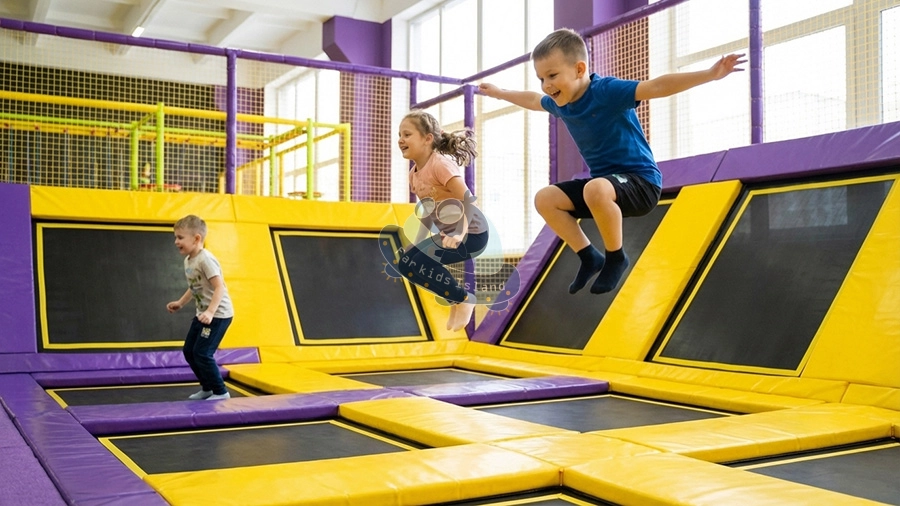
Trampoline parks are designed around repeated jumping, aerial movement, dodgeball, basketball dunk zones, foam pits, airbags, climbing elements, and related attractions. They can create strong visual energy and support timed sessions, birthday packages, group bookings, school outings, and corporate events. The format is particularly attractive to children, teenagers, and young adults seeking physical challenge rather than primarily imaginative play.
However, trampoline installations require more detailed structural and operational planning than many first-time investors expect. The building must accommodate adequate clear height, suitable floor loading, protected columns, controlled entry points, impact-absorbing interfaces, and clearly defined activity zones. Session capacity must be based on the manufacturer’s design, local code requirements, attraction type, and the operator’s risk-management program rather than simply on available floor area.
Operators should evaluate participant screening, age and size separation, safety briefings, staff positioning, emergency response, cleaning between sessions, and incident documentation. The U.S. Consumer Product Safety Commission trampoline park safety guidance highlights the importance of hazard awareness and injury prevention, but local legal, insurance, and regulatory requirements remain decisive.
Ninja courses: skill progression and repeat-visit potential
Ninja courses use obstacles such as stepping pods, balance beams, overhead rings, cargo nets, salmon ladders, swinging elements, warped walls, and climbing features. Their value lies in progression: participants can return to improve speed, strength, coordination, and completion rates. This makes the format suitable for open play, coached classes, camps, competitions, and membership programs.
The attraction typically appeals most strongly to school-age children, teenagers, fitness-oriented adults, and families interested in structured physical activity. A course can occupy less total area than a large trampoline park, but it still requires careful clearance planning, impact protection, fall zones, obstacle sequencing, and staff visibility. Design teams should assess whether obstacles are suitable for the intended age and ability range, with lower-height alternatives for beginners and accessible routes where appropriate.
Unlike a purely passive attraction, a ninja course can become a programming platform. Operators may sell introductory sessions, skill clinics, timed challenges, seasonal events, and private coaching. The commercial opportunity depends on qualified supervision and a clear progression system rather than on equipment alone.
Procurement Comparison for Investors and Operators
Core decision criteria
Before requesting quotations, buyers should prepare a project brief covering the venue’s usable dimensions, ceiling height, columns, fire exits, HVAC and electrical conditions, target capacity, age segmentation, expected peak periods, budget, theme direction, and opening date. A supplier cannot produce a reliable layout or price from gross square footage alone. Net play area, circulation, reception, toilets, party rooms, storage, staff areas, café seating, and emergency routes must be assessed together.
Safety documentation should be reviewed before commercial negotiations are finalized. Relevant references may include ASTM F1918, the standard safety specification for soft contained play equipment, applicable trampoline or amusement-device standards, local building and fire codes, and the project’s insurance conditions. ASTM references do not automatically replace local approval, so buyers should request a compliance matrix identifying which requirements are covered by the supplier and which remain the operator’s responsibility.
Comparative operating profile
| Evaluation factor | Indoor playground | Trampoline park | Ninja course |
|---|---|---|---|
| Typical primary audience | Toddlers, children, and families | Older children, teenagers, and active adults | School-age children, teenagers, and fitness users |
| Programming model | Open play, parties, daycare-style sessions | Timed jump sessions, parties, group events | Open play, classes, camps, competitions |
| Space sensitivity | Flexible footprint; height varies by structure | High ceiling and structural coordination are important | Clearance and fall-zone planning are critical |
| Operational complexity | Cleaning, inspection, age zoning, supervision | Session control, screening, briefings, high-energy supervision | Obstacle monitoring, progression control, coaching |
| Repeat-visit driver | New themes, parties, family convenience | Skill development, social play, memberships | Progression, timed challenges, classes, personal achievement |
| Primary procurement risk | Overcrowding and difficult-to-clean details | Insufficient clearance, weak operating controls, poor capacity assumptions | Unsuitable obstacle difficulty or inadequate fall protection |
The table provides a planning framework rather than a universal financial forecast. Revenue depends on admission pricing, utilization, local competition, party conversion, food and beverage sales, memberships, staffing, rent, maintenance, and marketing. Investors should build separate conservative, expected, and high-demand scenarios instead of relying on supplier claims about payback periods.
How to calculate value beyond the purchase price
A lower equipment quotation may create a higher total cost if the design causes bottlenecks, requires frequent repairs, lacks replacement-part availability, or cannot support the intended visitor volume. Total cost of ownership should include freight, customs, installation, commissioning, training, spare parts, cleaning supplies, inspection labor, insurance, periodic refurbishment, and future expansion.
Buyers should also compare the supplier’s engineering process. Useful evidence includes shop drawings, 3D renderings, material specifications, load or anchoring information where relevant, installation manuals, inspection checklists, warranty terms, and a documented change-control process. The ISO 12100 safety framework is widely used as a reference for machinery risk assessment; while not a substitute for attraction-specific requirements, its hazard-identification principles support a more systematic review.
Designing a Balanced Attraction Mix
Match equipment to the local customer profile
A neighborhood venue near schools may benefit from a strong soft-play and party-room proposition, while a destination mall may justify a larger mix with themed play, trampoline activities, and skill-based challenges. In a resort, weather-independent indoor recreation can increase guest value and extend dwell time. Market research should examine household age distribution, school calendars, competitor pricing, parking access, public transport, disposable income, and the availability of birthday venues.
Mixed concepts can improve cross-selling when circulation is planned correctly. A toddler zone can protect younger children from faster traffic, an activity court can support supervised sessions, and a ninja lane can create a visible challenge feature that encourages spectators to upgrade or return. The goal is not to place every attraction in one room, but to create complementary experiences with manageable supervision requirements.
Prioritize safety, hygiene, and accessibility from the start
Safety should be integrated during concept design rather than added after the equipment has been selected. Sightlines, entry control, age separation, impact attenuation, rounded edges, secure fasteners, fall zones, emergency access, and staff stations all influence the layout. Materials should be selected for durability, cleanability, low odor, and suitability for heavy commercial use.
Accessibility planning should consider routes, viewing areas, transfer opportunities, inclusive play components, signage, and local accessibility law. Inclusive design can improve the experience for families with different physical, sensory, or developmental needs while also making the venue easier for all visitors to navigate.
Build an operating model before approving the layout
Every attraction needs an operating playbook covering opening inspections, daily cleaning, scheduled maintenance, participant rules, staff-to-guest deployment, incident response, lost-child procedures, weather or power contingencies, and closure criteria. The ISO 45001 occupational health and safety principles offer a useful management-system perspective for identifying hazards, assigning responsibilities, and improving procedures over time.
Supplier training should be specific to the installed design. Staff need to understand equipment limitations, prohibited behavior, age rules, inspection points, and escalation procedures. A professional handover should include as-built documentation, maintenance schedules, spare-part references, and practical demonstrations rather than only a product brochure.
Why Far Kids Island Is a Turnkey Manufacturing Partner
Integrated design, engineering, and production
Far Kids Island is the global brand of Guangdong Tongshuo Industrial Co., Ltd., a commercial indoor and outdoor playground manufacturer based in Guangzhou, China. Established in 2012 with manufacturing roots dating back to 1993, the company brings more than 30 years of industry expertise to project development. Its 20,000 square meter manufacturing facility is supported by more than 200 professionals and over 20 senior design experts.
Our team combines research and development, custom 3D design, in-house production, and global sales. This integrated structure helps reduce communication gaps between concept design, fabrication, quality control, packing, and installation. For investors comparing indoor playground equipment and trampoline park equipment, a coordinated supplier can also improve dimensional accuracy, theme consistency, replacement-part planning, and project scheduling.
Turnkey support for family entertainment venues
Far Kids Island supports project owners from early space planning through theme development, manufacturing, professional installation, and operational training. Our design process can address toddler play, multilevel soft play, themed attractions, trampoline components, climbing features, ninja-style obstacles, party areas, and supporting circulation according to the project brief.
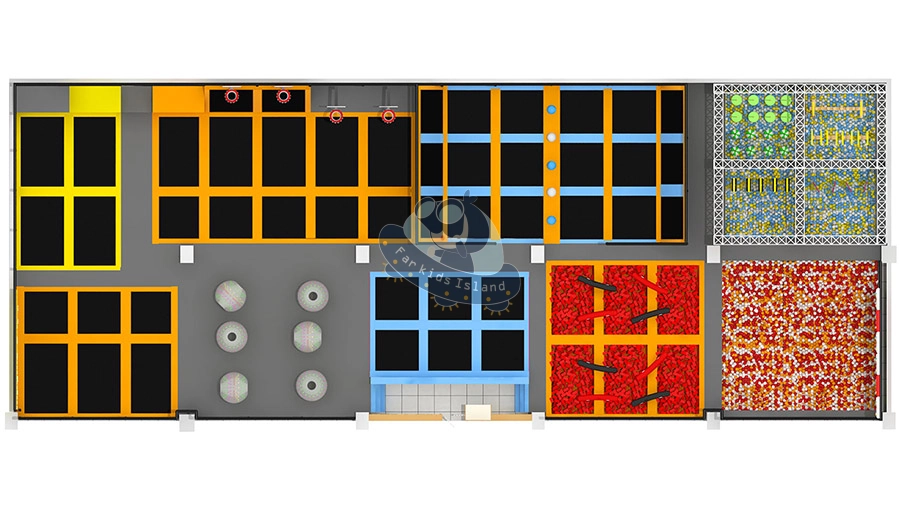
We do not treat the equipment list as the complete solution. Our team evaluates the available footprint, target visitors, traffic flow, visual identity, operational objectives, and expansion needs before recommending a configuration. Custom 3D visualization allows stakeholders to review the guest journey, play zoning, color palette, branding elements, and spatial relationships before production begins.
Material quality, certification, and international project experience
Guided by the philosophy “Designed for Children, Built for Safety,” Far Kids Island develops engaging and eco-conscious play environments for family entertainment centers, schools, shopping malls, and resorts. We use non-toxic, commercial-grade sustainable materials supported by ASTM and COC certifications for applicable products and projects. Buyers should still confirm the exact certificate scope, issuing body, test date, and destination-market requirements for each quotation.
Far Kids Island has exported playground solutions to clients in more than 30 countries. This international exposure supports practical coordination across different site conditions, languages, shipping arrangements, and installation requirements. A reliable global supplier should provide clear technical drawings, packing documentation, installation guidance, after-sales communication, and a defined process for warranty or replacement-part requests.
For investors, the most important comparison is not simply soft play versus trampolines versus ninja obstacles. It is whether the selected attraction can be safely operated, efficiently maintained, commercially programmed, and adapted to the venue’s long-term strategy. A data-based concept brief, transparent compliance review, and capable manufacturing partner create a stronger foundation for visitor satisfaction and return on investment.
Frequently Asked Questions
Which attraction is best for a new family entertainment center?
The best choice depends on local demographics, available ceiling height, floor area, target age groups, staffing capacity, insurance requirements, and the desired business model. Indoor playgrounds offer broad family appeal, trampoline parks suit high-energy users, and ninja courses support skill progression and repeat visits.
What should buyers check before purchasing trampoline park equipment?
Buyers should evaluate clear height, floor loading, protected columns, impact-absorbing interfaces, controlled entry points, activity zoning, participant screening, safety briefings, staff positioning, emergency response, cleaning, and incident documentation.
How can an operator increase repeat visits with a ninja course?
Operators can offer skill progression, introductory sessions, coached classes, camps, competitions, timed challenges, memberships, and private coaching so participants have measurable reasons to return.
What documents should a playground equipment supplier provide?
A supplier should provide shop drawings, 3D renderings, material specifications, relevant load or anchoring information, installation manuals, inspection checklists, warranty terms, replacement-part information, and a documented change-control process.
Does ASTM certification automatically guarantee local compliance?
No. ASTM references support safety evaluation, but buyers must also confirm local building, fire, accessibility, amusement-device, insurance, and licensing requirements. The supplier and project owner should create a compliance matrix defining each party’s responsibility.
What services does Far Kids Island provide for FEC projects?
Far Kids Island provides space planning, custom 3D design, theme development, in-house manufacturing, professional installation, operational training, and global project support for commercial indoor and outdoor playground solutions.
Turnkey Custom Indoor Playground Solutions for Developers
Commercial Indoor Playground Equipment Manufacturer: Private Label
Custom Soft Play Design Solutions for Family Entertainment Centers
Commercial Indoor Playground Equipment Safety Standards & Certifications
Top Project Picks for Your Next Success


Have Questions or Need More Information?
Ready to Dive Deeper into This Topic?
Explore Detailed Insights and Start Applying Knowledge to Your Project
We’re here to help! Fill out the form below to reach out to our team. Whether you have a question about the article or need assistance with your project, we’re happy to assist you.
Trusted Playground Solution Provider
Professional one-stop indoor playground solutions with a strong focus on design, safety, and eco-friendly materials.
Our Location
No. 106, No. 27, Jiejin 2nd Road, Shiqiao Street, Panyu District, Guangzhou, China.
Say Hello
Social Links
Whatsapp: +8613632109166
TongShuo Toys
sullaguo
Far kids island
TONGSHUO
Guo Wenshu