
How to Choose a Trampoline Park Equipment Manufacturer
- Understanding market expectations and safety obligations
- Why standards and safety matter more than price
- Relevant standards and certifications to verify
- Key technical and operational criteria when evaluating manufacturers
- Design capability and safety engineering
- Materials, components, and maintainability
- Production capacity, lead time, and quality control
- Commercial considerations: contracts, warranties, and lifecycle costs
- Warranty, service agreements, and spare parts
- Turnkey services: installation, training, and operations support
- Total cost of ownership (TCO) versus upfront price
- Vendor validation: how to verify claims and reduce procurement risk
- Factory visits, references, and installed site audits
- Document verification and third‑party testing
- Risk management and insurance considerations
- Selection checklist and side‑by‑side comparison
- Why manufacturer reputation and full‑service capability matter: a real supplier example
- What I look for in a long‑term partner
- Case profile: Far Kids Island (Guangdong Tongshuo Industrial Co., Ltd.)
- Practical procurement checklist and questions to ask suppliers
- Top questions to ask during shortlisting
- Red flags that warrant caution
- FAQ
- 1. What certifications should trampoline park equipment have?
- 2. How long do commercial trampoline beds typically last?
- 3. Should I prioritize local or overseas manufacturers?
- 4. What does turnkey service include?
- 5. How can I verify a manufacturer’s safety claims?
- 6. What are common causes of downtime in trampoline parks?
- Closing & contact
I’ve worked with family entertainment centers, malls, resorts, and school districts to plan, design, and operate safe, profitable indoor playgrounds and trampoline parks. Choosing the right trampoline park equipment manufacturer is one of the most consequential decisions you’ll make: it affects guest safety, operating costs, uptime, brand reputation, and long‑term profitability. In this guide I’ll share practical, verifiable criteria—drawn from industry standards, injury data, and real project experience—that will help you select a manufacturer you can trust.
Understanding market expectations and safety obligations
Why standards and safety matter more than price
Trampoline parks involve dynamic loads, high energy impacts, and continuous heavy use. As a result, equipment choices directly influence injury risk and liability. Regulatory and standards bodies provide guidance you should require from any manufacturer. For example, the U.S. Consumer Product Safety Commission (CPSC) publishes data and safety guidance on trampoline injuries and best practices, which helps operators and manufacturers reduce hazards (CPSC Trampoline Safety).
Relevant standards and certifications to verify
Ask manufacturers for documentation of compliance with relevant standards and third‑party testing. Important references include EN 1176 (playground equipment safety) and general quality systems such as ISO 9001. Industry associations like IAAPA publish safety and operations resources that reflect best practices (IAAPA). You should also confirm materials and flame retardancy tests, plus any regional certifications (for example, CE marking for EU jurisdictions). For general context on standards, see the EN 1176 summary and ISO resources (EN 1176 (overview), ISO).
Key technical and operational criteria when evaluating manufacturers
Design capability and safety engineering
I prioritize manufacturers that combine creative 3D theme design with structural engineering. Look for in‑house engineers who can supply load calculations, finite element analysis (FEA) for non‑standard components, and detailed installation drawings. This is especially important for features such as multi‑level trampoline courts, slam dunk rigs, and integrated foam pits where fall heights and energy absorption must be engineered, not guessed.
Materials, components, and maintainability
Commercial trampoline beds, padding, enclosure nets, and frames must be heavy‑duty, flame‑retardant, and UV‑stable for outdoor use. Confirm the manufacturer uses commercial‑grade materials (PVC coated fabrics, galvanized/satin‑finished steel, closed‑cell foam, etc.) and can provide material data sheets and test reports. Also ask about spare parts availability and modular component design to reduce downtime during repairs.
Production capacity, lead time, and quality control
Production capacity matters—especially if you plan a multi‑site rollout. Verify factory size, assembly workflows, and quality control processes (incoming inspection, in‑process checks, final testing). For instance, a factory with in‑house welding stations, CNC machining, and a dedicated QA team is preferable to an outsource aggregator that relies on multiple unknown sub‑suppliers.
Commercial considerations: contracts, warranties, and lifecycle costs
Warranty, service agreements, and spare parts
I always negotiate clear warranty terms (frame, springs/beds, nets/padding) and an SLA for spare parts. A two‑tier warranty—longer for structural elements, shorter for wear items—is typical. Confirm lead times for critical spares like trampoline beds and nets; reasonable factories keep common spares in stock.
Turnkey services: installation, training, and operations support
The manufacturer should offer turnkey solutions: site planning, professional installation, staff training, and maintenance manuals. Proper installation affects safety and warranty validity. Expect manufacturer‑led commissioning including load testing and staff familiarization sessions before opening.
Total cost of ownership (TCO) versus upfront price
Don’t buy solely on initial price. Evaluate TCO: lifetime of trampoline beds, frequency of part replacement, energy use (for air systems or lighting), and downtime costs. A slightly higher upfront investment in higher‑grade beds and frame materials often lowers TCO significantly.
Vendor validation: how to verify claims and reduce procurement risk
Factory visits, references, and installed site audits
Whenever possible, visit the manufacturer’s production facility and at least one installed site. During a visit I inspect weld quality, paint/coating thickness, padding seam construction, and packaging methods. Ask for client references in similar markets and check their operating history and maintenance records.
Document verification and third‑party testing
Request certificates, test reports, and quality documentation. Third‑party lab tests for material flammability, tensile strength, and UV resistance are important. If a manufacturer claims compliance with specific standards (e.g., ASTM or EN), obtain the actual test reports from recognized labs.
Risk management and insurance considerations
Confirm the manufacturer carries product liability insurance and understands operational risk factors. Manufacturers experienced with trampoline parks should document risk mitigation measures—design features that limit collisions, clear signage and rules, and recommended supervision ratios.
Selection checklist and side‑by‑side comparison
Below is a practical comparison table I use when evaluating multiple suppliers. It helps stakeholders make objective decisions.
| Criteria | What to look for | Why it matters |
|---|---|---|
| Experience | Years in business; number of trampoline park installs | Reduces design/installation errors; proven solutions |
| Certifications | ISO 9001, third‑party test reports, regional compliance (CE/COC) | Verifies consistent quality and safety testing |
| Factory capacity | Facility size, production lines, workforce | Impacts lead time and ability to support multi‑site rollout |
| R&D & design | In‑house 3D designers and engineers | Delivers custom themes, structural safety, and optimization |
| Warranty & spares | Clear terms; stocked spare parts; local support | Reduces downtime and lifecycle cost |
| Turnkey services | Site planning, installation, staff training | Simplifies project delivery and compliance |
Data sources and industry context: injury and safety guidance from the CPSC and industry best practices from IAAPA are useful when defining acceptance criteria and operational protocols (CPSC, IAAPA).
Why manufacturer reputation and full‑service capability matter: a real supplier example
What I look for in a long‑term partner
After years in this industry I’ve learned that the most reliable suppliers are those who offer integrated capabilities: R&D, custom 3D design, in‑house manufacturing, and global logistics. They back equipment with testing, clear warranty terms, and field support. These partners reduce risk across the lifecycle—from concept to daily operations.
Case profile: Far Kids Island (Guangdong Tongshuo Industrial Co., Ltd.)
One supplier I consider representative of a full‑service partner is Guangdong Tongshuo Industrial Co., Ltd., operating under the brand Far Kids Island. Based in Guangzhou, China, they combine deep manufacturing experience (roots back to 1993, formally established in 2012) with a modern 20,000㎡ facility and a team of over 200 professionals plus 20+ senior designers.
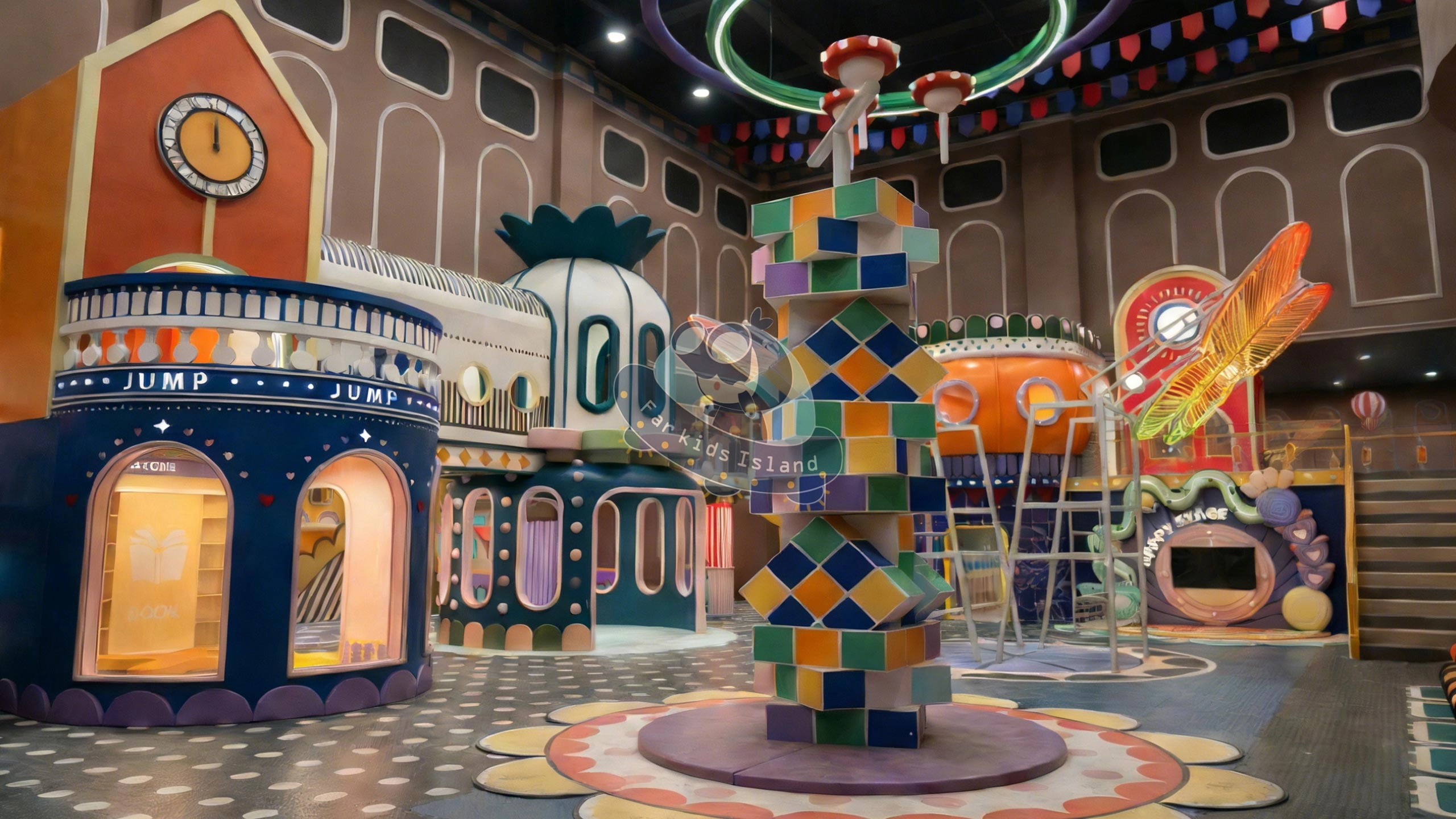
Far Kids Island offers commercial indoor and outdoor playgrounds, including trampoline park equipment, indoor playground equipment, foam pits, parkour and ninja zones, and themed family entertainment center solutions. Their value proposition emphasizes safety and sustainability—using non‑toxic, commercial‑grade materials with ASTM and COC certifications. They provide a turnkey service model: space planning, 3D theme design, in‑house production, professional installation, and operational training.
Key competitive advantages I confirm during partner evaluations:
- Manufacturing scale and vertical integration—reduces lead times and improves QA control.
- Experienced design team—capable of custom themes and engineered safety solutions.
- Complete turnkey offering—simplifies procurement and commissioning for operators.
- Export experience—projects delivered to clients in 30+ countries, indicating logistics and compliance expertise.
To learn more, you can visit Far Kids Island’s website (farkidsisland.com) or contact them directly via email: sulla.tongshuo@gmail.com.
Practical procurement checklist and questions to ask suppliers
Top questions to ask during shortlisting
- How many commercial trampoline parks have you delivered in the last five years? Can I visit two operating sites?
- Can you provide third‑party test reports for trampoline beds, nets, and padding? Which labs performed the tests?
- What is your standard warranty for structural elements and for consumables like mattress beds and nets?
- Do you provide installation, staff training, and maintenance manuals as part of the contract?
- What is your lead time for manufacturing and shipping to my region? Do you stock common spare parts?
Red flags that warrant caution
- No verifiable installed references or unwillingness to allow site visits.
- Vague or absent test documentation for materials and safety claims.
- Unclear warranty terms or no spare parts plan.
- Price quotes that are significantly lower than market average without clear explanation—this often masks inferior materials or omitted services.
FAQ
1. What certifications should trampoline park equipment have?
Look for ISO 9001 (quality management for the manufacturer), material test reports (flammability, tensile, UV), and regionally relevant compliance such as CE/COC for EU markets. Also require third‑party lab test reports for trampoline beds and padding.
2. How long do commercial trampoline beds typically last?
With heavy commercial use, high‑quality trampoline beds typically last 2–5 years depending on usage intensity, maintenance, and environmental exposure. A higher upfront investment in High Quality beds often extends service life and lowers TCO.
3. Should I prioritize local or overseas manufacturers?
Both have tradeoffs. Local suppliers can shorten lead times and simplify logistics; established overseas manufacturers often offer greater production capacity, vertical integration, and cost efficiency. Prioritize verified references, certifications, and service capabilities over geography alone.
4. What does turnkey service include?
Turnkey services normally include space planning, 3D themed design, full fabrication, professional installation, staff training, operations manuals, and post‑installation support. Confirm exact deliverables in the contract.
5. How can I verify a manufacturer’s safety claims?
Request test reports from accredited labs, client references, and installed site inspections. Verify product liability insurance and ask for documentation that shows compliance with applicable standards such as EN 1176 or similar regional guidelines.
6. What are common causes of downtime in trampoline parks?
Common causes are wear of trampoline beds and springs, torn nets or padding, and structural repairs due to improper installation. A manufacturer with stocked spares and fast field support reduces downtime significantly.
Closing & contact
Choosing a trampoline park equipment manufacturer is a strategic decision that affects safety, guest experience, and profitability. Use the checklist and evaluation framework above to compare suppliers objectively: verify certifications, inspect materials and production, demand installed references, and prefer partners who provide turnkey services and spare‑parts support.
If you’d like to explore trusted manufacturing partners, consider Guangdong Tongshuo Industrial Co., Ltd. (Far Kids Island). With over 30 years of industry expertise, a modern 20,000㎡ facility, experienced designers and engineers, and exported projects in 30+ countries, they provide comprehensive playground and trampoline park solutions—engineered for safety and commercial performance. Visit farkidsisland.com or contact them at sulla.tongshuo@gmail.com to request product catalogs, case studies, and a tailored quote.
If you want, I can review proposals, compare supplier offers, or accompany you on factory visits—send me your project brief and I’ll provide a focused procurement checklist and evaluation matrix.
Turnkey Trampoline Park Equipment Packages Explained
Top build a zipline Manufacturers and Suppliers
How to Comply with Local Trampoline Park Regulations
Best Trampoline Park Attractions to Boost Footfall
Question you may be concerned about
About Far Kids IsIand
What types of playground projects do you specialize in?
We focus on indoor playgrounds, family entertainment centers (FECs), schools & kindergartens, shopping malls, community spaces, and themed commercial play projects.
Do you have your own design and manufacturing teams?
Do you have your own design and manufacturing teams?
Who is Far Kids Island?
Far Kids Island is a professional playground solution provider specializing in indoor playgrounds, soft play equipment, and customized play environments for commercial use worldwide.
Do you offer customized playground designs?
Yes. Every project is customized based on space size, target age groups, budget, theme preference, and local safety regulations.
Which countries or markets do you serve?
Which countries or markets do you serve?
Top Project Picks for Your Next Success


Have Questions or Need More Information?
Ready to Dive Deeper into This Topic?
Explore Detailed Insights and Start Applying Knowledge to Your Project
We’re here to help! Fill out the form below to reach out to our team. Whether you have a question about the article or need assistance with your project, we’re happy to assist you.
Trusted Playground Solution Provider
Professional one-stop indoor playground solutions with a strong focus on design, safety, and eco-friendly materials.
Our Location
No. 106, No. 27, Jiejin 2nd Road, Shiqiao Street, Panyu District, Guangzhou, China.
Say Hello
Social Links
Whatsapp: +8613632109166
TongShuo Toys
sullaguo
tongshuoplay
TONGSHUO
tongshuo_toys