





2026 Trends in commercial trampoline park equipment Purchasing
- How Trampoline Park Procurement Is Changing in 2026
- Lifecycle value is replacing lowest-price purchasing
- Safety evidence is becoming a procurement requirement
- Modular attractions are supporting flexible revenue planning
- Design and Technology Priorities for Modern Indoor Activity Venues
- Data-informed space planning improves capacity and circulation
- Digital features should support operations, not distract from safety
- Inclusive and multi-generational recreation is expanding the addressable market
- Procurement Checklist for Commercial Jump and Play Facilities
- Evaluate the supplier’s technical and manufacturing capacity
- Compare proposals using a weighted decision matrix
- Plan installation, commissioning, and maintenance before ordering
- Why Far Kids Island Fits 2026 Turnkey Playground Projects
- Integrated design and manufacturing for customized venues
- Safety-focused materials and documented project support
- Global experience with a practical commercial focus
- Frequently Asked Questions
In 2026, purchasing commercial trampoline park equipment is becoming a strategic facilities decision rather than a simple product transaction. Investors and family entertainment center operators are evaluating safety documentation, visitor flow, revenue density, maintainability, inclusivity, energy use, and total lifecycle cost alongside visual appeal. The strongest buying strategy combines engineered jumping zones, climbing and ninja activities, soft-play integration, digital booking compatibility, professional installation, and a documented inspection program. Buyers should compare suppliers by technical evidence and project support, not by catalog size or initial quotation alone.
How Trampoline Park Procurement Is Changing in 2026
Lifecycle value is replacing lowest-price purchasing
Operators increasingly recognize that a low initial price can create higher costs through frequent replacement, downtime, difficult cleaning, damaged padding, and limited access to spare parts. A more reliable evaluation considers the complete ownership cycle: design, manufacturing, shipping, installation, staff training, routine inspection, repairs, component replacement, and eventual refurbishment. A supplier quotation should identify the specifications of springs, jumping mats, steel frames, padding, netting, fasteners, anchors, flooring, and protective coverings. It should also state which components are standardized and available for future replacement.
Total cost of ownership should be connected to the business model. A high-capacity venue may benefit from modular zones that can be closed individually during maintenance, while a smaller location may need compact attractions that produce several activities within a limited footprint. Buyers should request an operating assumption sheet covering expected daily users, recommended age groups, supervision requirements, cleaning intervals, and inspection frequency. These details make it easier to compare proposals on a consistent basis.
Safety evidence is becoming a procurement requirement
Safety claims should be supported by verifiable documents rather than general statements such as “High Quality quality” or “international standard.” The ASTM commercial trampoline park standard provides a recognized reference for the design, manufacture, installation, operation, maintenance, inspection, and major modification of commercial trampoline parks. Buyers should ask how the proposed layout and components address edge protection, entrapment risks, fall zones, user separation, access control, emergency response, and inspection records.
Manufacturing safety also depends on process control. Welding procedures, powder coating, foam density, fabric strength, flame-performance documentation, load assumptions, and fastener quality should be traceable to production records. Where structural or mechanical risks exist, project owners can use the principles of ISO 12100 risk assessment as a useful framework for identifying hazards, reducing risks through design, and documenting residual risks for operators.
Modular attractions are supporting flexible revenue planning
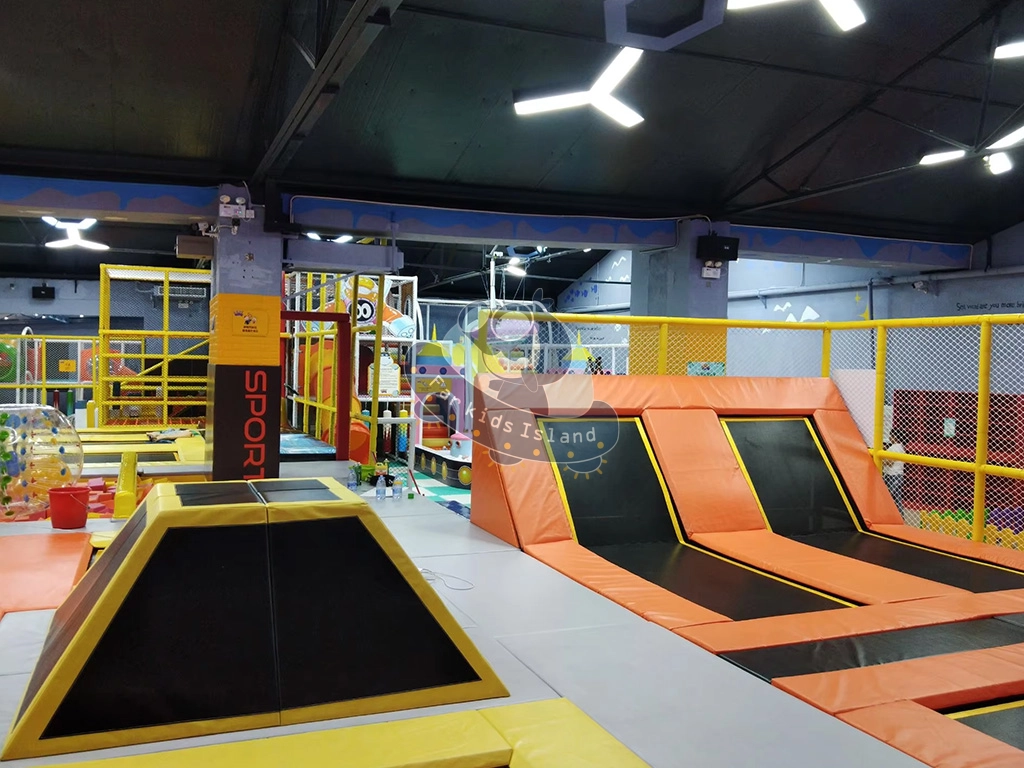
Fixed layouts can become commercially limiting when customer preferences, age demographics, or tenant requirements change. In 2026, modular platforms, replaceable padding, reconfigurable obstacles, and separately operated activity zones are becoming more important. A venue might combine an open jump court with dodgeball, basketball dunk lanes, a toddler soft-play area, a ninja course, a climbing wall, or a birthday-party room. This approach allows an operator to refresh selected zones without rebuilding the entire facility.
Modularity must not compromise structural integrity. Any movable or replaceable component should have a defined connection method, installation sequence, inspection criterion, and compatibility specification. Buyers should avoid mixing components from different manufacturers unless the supplier confirms that interfaces, dimensions, impact performance, and maintenance requirements are compatible.
Design and Technology Priorities for Modern Indoor Activity Venues
Data-informed space planning improves capacity and circulation
Three-dimensional planning is now an essential procurement tool. A useful model should show ceiling clearance, columns, HVAC equipment, fire exits, emergency routes, spectator areas, reception, shoe storage, party rooms, staff sightlines, and service access. It should also distinguish active landing zones from circulation paths and waiting areas. This prevents a common project failure: selecting attractive attractions that create congestion or obstruct supervision.
Capacity should be calculated conservatively. The venue needs clear rules for maximum simultaneous users, age or height separation, session duration, queue behavior, and staff positioning. The U.S. Consumer Product Safety Commission trampoline safety guidance reinforces the importance of supervision and safe-use controls. Although operational requirements differ by jurisdiction, a procurement brief should require visible rules, trained attendants, incident procedures, and a layout that enables staff to identify unsafe behavior quickly.
Digital features should support operations, not distract from safety
Technology is appearing in booking systems, timed sessions, electronic waivers, occupancy monitoring, scoring displays, interactive games, and customer loyalty programs. These features can increase throughput and repeat visits, but they should be selected according to operational value. A digital scoring system that requires constant troubleshooting may reduce productivity, while a simple reservation and capacity platform can improve labor planning and reduce queues.
Buyers should clarify data ownership, software subscriptions, network requirements, warranty coverage, cybersecurity responsibilities, and offline procedures before approving interactive features. Hardware should be positioned away from impact areas and designed for cleaning. The technology plan should also include accessible controls and clear alternatives for visitors who cannot or do not wish to use digital interfaces.
Inclusive and multi-generational recreation is expanding the addressable market
Modern indoor playground equipment is increasingly designed for different ages, abilities, and confidence levels. A successful venue can include low-height activity areas, sensory-friendly sessions, accessible routes, seated rest points, visual wayfinding, and activities that do not depend exclusively on jumping. Family groups are more likely to stay longer when toddlers, older children, teenagers, and accompanying adults have suitable choices within the same destination.
Inclusive design should be addressed at the planning stage rather than added after installation. Buyers should discuss transfer points, ramp gradients, clear widths, tactile or visual cues, noise management, lighting levels, and staff assistance procedures with the designer. Local building codes, accessibility regulations, fire requirements, and insurance conditions remain decisive and must be reviewed by qualified local professionals.
Procurement Checklist for Commercial Jump and Play Facilities
Evaluate the supplier’s technical and manufacturing capacity
A credible manufacturer should explain how design drawings become controlled production documents. Buyers can request a factory profile, quality-control plan, material specifications, welding and coating procedures, sample inspection records, packaging standards, and a list of typical lead times. The supplier should identify which work is performed in-house and which processes are outsourced. In-house design and production can simplify communication, but the buyer still needs documented acceptance criteria.
Reference projects are most useful when they are comparable in climate, footprint, user volume, and attraction mix. Ask whether the supplier has delivered projects for shopping malls, resorts, schools, family entertainment centers, or independent venues. A project reference should ideally include the installed scope, commissioning process, maintenance experience, and availability of replacement parts rather than only promotional photographs.
Compare proposals using a weighted decision matrix
Price should be one factor in a structured evaluation, not the only factor. A practical scoring model can assign weight to safety documentation, design quality, material durability, installation support, delivery schedule, warranty, spare parts, operator training, customization, and lifecycle cost. The weighting should reflect the project’s risk and revenue model. For example, a high-volume urban FEC may place greater emphasis on maintainability and rapid component replacement, while a resort may prioritize theme integration and weather-resistant adjacent attractions.
| Procurement criterion | Evidence to request | Why it matters |
|---|---|---|
| Safety and compliance | Applicable standards, risk assessment, material and fire documentation | Supports safer design review, insurance discussions, and operational controls |
| Durability | Material specifications, coating process, load assumptions, replacement schedule | Helps predict maintenance demands and downtime |
| Layout efficiency | Scaled 3D drawings, circulation plan, capacity assumptions, sightline study | Improves visitor flow, supervision, and usable revenue space |
| Project delivery | Production milestones, packing list, installation plan, commissioning checklist | Reduces delays, missing parts, and installation disputes |
| After-sales service | Warranty terms, spare-parts process, response times, training materials | Protects long-term operating continuity |
Plan installation, commissioning, and maintenance before ordering
Installation is a technical phase, not merely an assembly task. The project schedule should account for floor conditions, anchoring, ceiling height, electrical points, ventilation, fire protection, delivery access, local labor, and inspection by relevant authorities. A professional commissioning process should verify fasteners, padding coverage, net tension, mat placement, clearances, signage, emergency access, and staff understanding of operating procedures.
Maintenance documentation should include daily visual checks, scheduled inspections, cleaning methods, prohibited chemicals, component replacement thresholds, incident reporting, and a process for isolating damaged zones. Operators should maintain an asset register with installation dates, inspection results, repairs, and replacement history. This documentation supports consistent management and helps identify recurring failure patterns before they affect customer safety or revenue.
Why Far Kids Island Fits 2026 Turnkey Playground Projects
Integrated design and manufacturing for customized venues
Guangdong Tongshuo Industrial Co., Ltd., operating under the globally trusted Far Kids Island brand, is a manufacturer of commercial indoor and outdoor playgrounds based in Guangzhou, China. Established in 2012 with manufacturing roots dating back to 1993, the company brings more than 30 years of industry expertise to project development. Its 20,000-square-meter manufacturing facility is supported by more than 200 professionals and over 20 senior design experts.
Our team integrates research and development, custom 3D design, in-house production, and global sales. This structure helps buyers coordinate theme development, spatial planning, attraction selection, manufacturing, packaging, installation, and operational preparation through one project partner. For investors comparing indoor playground equipment and trampoline park solutions, the integrated workflow can reduce communication gaps between designers, fabricators, and installation teams.
Safety-focused materials and documented project support
Our philosophy is “Designed for Children, Built for Safety.” Far Kids Island develops engaging play environments for schools, family entertainment centers, shopping malls, resorts, and other commercial destinations. The product scope can include jump courts, soft-play structures, climbing features, ninja elements, ball pits, slides, interactive zones, and themed indoor attractions, subject to the site brief and local compliance requirements.
We use non-toxic, commercial-grade sustainable materials and support applicable projects with ASTM and COC certifications. Documentation should always be reviewed against the exact product configuration, destination-country requirements, and authority approvals. Our turnkey service covers space planning, theme development, custom design, production, professional installation, and operational training, giving project owners a clearer path from concept approval to opening day.
Global experience with a practical commercial focus
Far Kids Island has exported playground solutions to clients in more than 30 countries. International delivery requires attention to packaging, container utilization, documentation, communication across time zones, local installation conditions, and after-sales support. Our global project experience is intended to help distributors, brand owners, and facility operators manage these practical requirements while developing a distinctive customer experience.
The strongest 2026 purchasing decision is not necessarily the largest attraction package. It is the solution that matches the building, audience, staffing model, risk controls, capital plan, and maintenance capability. Buyers should therefore submit a detailed brief covering dimensions, ceiling height, target age groups, expected attendance, theme direction, budget range, local standards, delivery location, and desired opening date. A qualified supplier can then develop a safer and more commercially realistic proposal instead of offering a generic catalog layout.
Frequently Asked Questions
What should buyers prioritize when purchasing trampoline park equipment in 2026?
Buyers should prioritize documented safety, lifecycle value, modular design, maintainability, inclusive recreation, professional installation, operator training, and reliable after-sales support rather than focusing only on the initial price.
Which safety documents should a trampoline park supplier provide?
A supplier should provide applicable standards, risk-assessment information, material specifications, fire-performance documentation where required, structural or load information, inspection guidance, warranty terms, and records showing how quality is controlled during manufacturing.
How can operators reduce maintenance downtime?
Operators can reduce downtime by selecting modular attractions, standardized replaceable components, accessible inspection points, documented cleaning procedures, spare-parts support, scheduled inspections, and layouts that allow individual activity zones to close without shutting the entire venue.
Why is 3D space planning important for an indoor activity center?
Three-dimensional planning shows ceiling clearance, columns, exits, circulation routes, staff sightlines, spectator areas, service access, and activity capacity before production begins, helping prevent congestion, poor supervision, and costly layout changes.
Can trampoline attractions be combined with other indoor playground equipment?
Yes. A venue can combine jump courts with soft play, climbing features, ninja activities, basketball dunk lanes, dodgeball, toddler zones, party rooms, and interactive attractions when the layout, user separation, fall zones, supervision, and local compliance requirements are properly addressed.
What services should a turnkey playground manufacturer include?
A turnkey manufacturer may provide space planning, custom 3D design, theme development, engineering coordination, in-house production, packaging, professional installation, commissioning, staff training, maintenance guidance, and after-sales spare-parts support.
Indoor Playground Equipment Cost Checklist: Questions to Ask Before Choosing a Manufacturer and Placing an Order
indoor soft play equipment MOQ, Pricing and Bulk Order Terms
Warranty, Service Contracts and After-Sales for Soft Play Suppliers
5000 sqm Trampoline Adventure Park: Layout, Attractions & Project Planning
Top Project Picks for Your Next Success


Have Questions or Need More Information?
Ready to Dive Deeper into This Topic?
Explore Detailed Insights and Start Applying Knowledge to Your Project
We’re here to help! Fill out the form below to reach out to our team. Whether you have a question about the article or need assistance with your project, we’re happy to assist you.
Trusted Playground Solution Provider
Professional one-stop indoor playground solutions with a strong focus on design, safety, and eco-friendly materials.
Our Location
No. 106, No. 27, Jiejin 2nd Road, Shiqiao Street, Panyu District, Guangzhou, China.
Say Hello
Social Links
Whatsapp: +8613632109166
Far kids island
Far kids island
Far kids island
TONGSHUO
Guo Wenshu